Stock certificate requirements for a New York corporation
NY BCL §§ 508 and 506 govern stock certificates in New York. The required content tracks federal MBCA standards, with New York-specific provisions on form and signing.
| NY BCL § 508 | Form of share certificates; uncertificated shares |
|---|---|
| NY BCL § 506 | Consideration and payment for shares |
| NY BCL § 626 | Shareholders' derivative action |
| NY BCL § 504 | Authorized shares; statement of rights |
| NY BCL § 622 | Action by directors without meeting |
- BCL § 508 prescribes content: corporation name, state of incorporation, shareholder name, class and number of shares, par value
- Two signatures required: chairperson/president/VP and secretary/treasurer or assistant; facsimile permitted
- Section 508(c) permits the corporation to issue uncertificated shares, with notice to the holder of the rights and restrictions
- Transfer restrictions and securities-law legends must be conspicuously stated to bind transferees
- Replacement of lost certificates governed by BCL § 510 on satisfactory proof of loss
Required content under BCL § 508
A New York stock certificate must state:
- The name of the corporation and the state under whose laws it is organized
- The name of the registered shareholder
- The class and number of shares represented, and the series if applicable
- The par value of the shares, or a statement that they are without par value
- If the corporation has multiple classes or series of shares with different rights, a statement of those rights, or alternatively, a statement that the corporation will provide a description of those rights without charge on request
Section 504 requires the statement of rights to be complete enough that a shareholder can determine the relative rights of the class held without further inquiry.
Signing and uncertificated shares
NY BCL § 508(b) requires two officer signatures on a stock certificate. The combinations are: the chair, vice-chair, president, or any vice-president, plus the secretary, assistant secretary, treasurer, or assistant treasurer. Facsimile signatures are permitted, and many New York corporations issue certificates with printed officer signatures and a corporate seal.
Section 508(c) permits the corporation to issue uncertificated shares. Where uncertificated shares are issued, the corporation must send a written notice to the shareholder describing the rights, preferences, and restrictions of the shares, effectively delivering on paper what would otherwise appear on the face of a certificate.
Transfer restrictions and legends
New York follows the general US approach: transfer restrictions are enforceable against transferees who took with notice. To establish notice, the restriction must be conspicuously stated on the face of the certificate (for certificated stock) or in a notice delivered to the holder (for uncertificated). Securities-law legends for Rule 506 private placements and equivalent state exemptions are standard for shares issued in financings.
Replacement of lost certificates
BCL § 510 governs replacement of lost, stolen, or destroyed certificates. The corporation may issue a new certificate on receipt of an affidavit of loss, an indemnity bond against future claims (often calibrated to the value of the shares), and payment of a reasonable fee. The original certificate is cancelled in the corporation's stock ledger; the replacement carries a new certificate number.
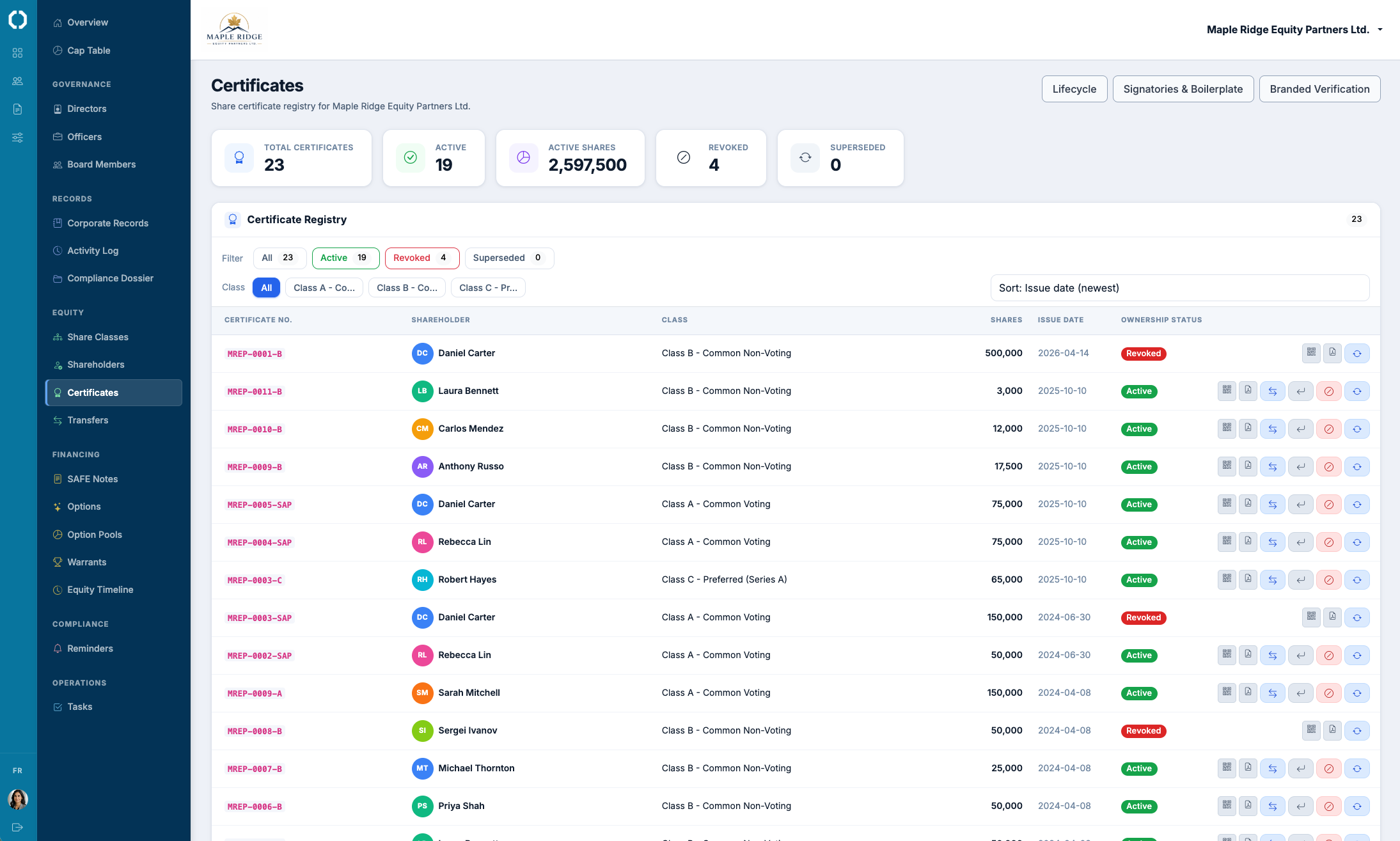
Octelligence issues share certificates with QR codes that resolve to a public verification page. Cancellations and reissuances flow through the same workflow as issuance, so the certificate, the register, and the cap table stay aligned.
See Digital Corporate RecordsQR-verified share certificates, public verification pages, and a register that always agrees with the certificate in hand.