Delaware corporate diligence checklist
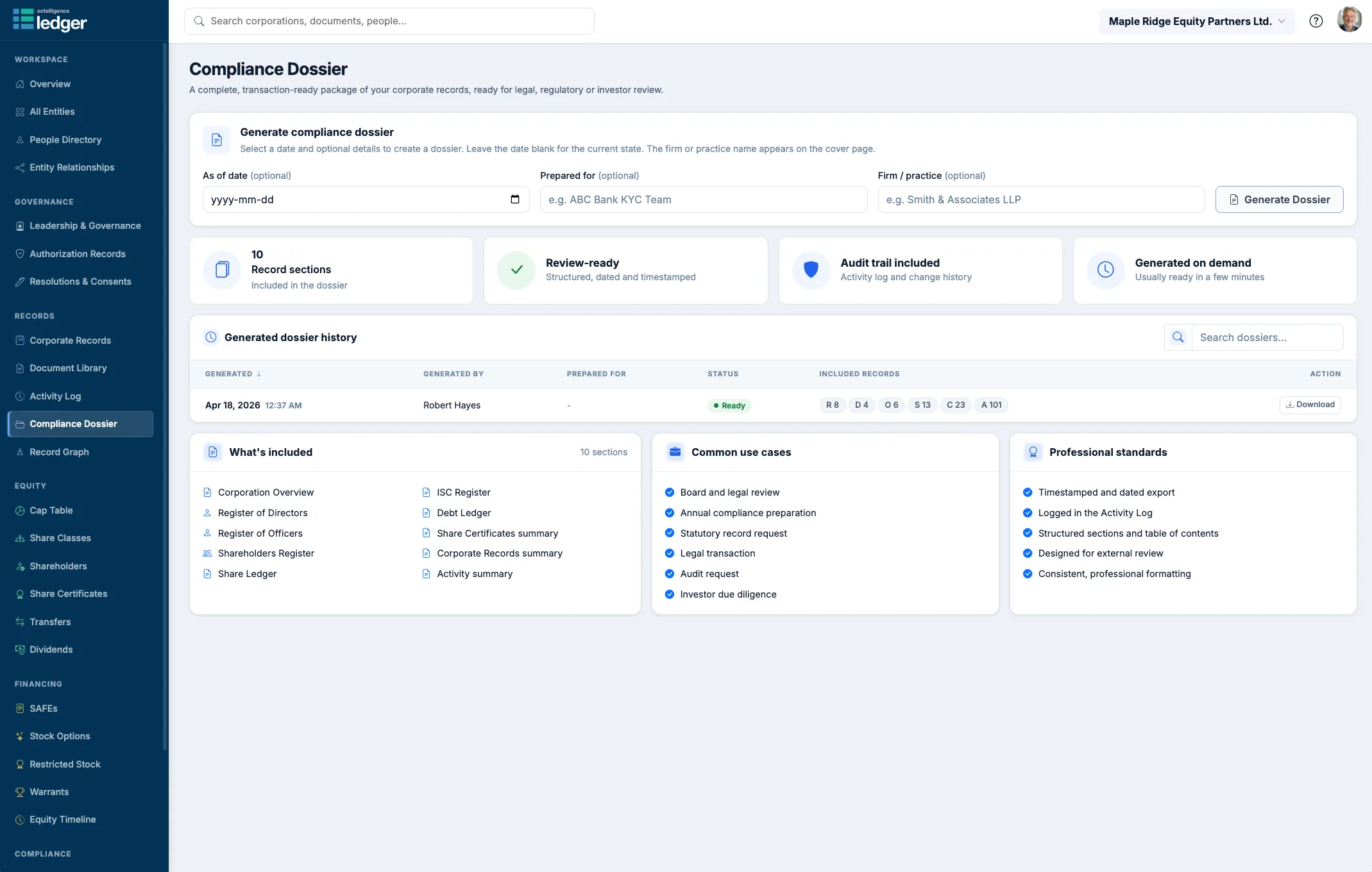
What diligence counsel reviewing a Delaware corporation will request, ordered by sequence: records to produce, cap-table items to reconcile, filings to verify, and the failure points investors most often find. Each item below traces back to a specific obligation under Delaware General Corporation Law, 8 Del. C. tit. 8.
| Statute family | DGCL |
|---|---|
| Records standard | books and records under the state corporation statute |
| Inspection rights | Shareholders and (in most cases) creditors and beneficial owners |
| Diligence trigger | Financing, M&A, lender review, regulatory examination |
- Produce the DGCL records bundle: articles, bylaws, registers, resolutions, and certificates
- Reconcile the cap table against the share register, certificate-by-certificate
- Show all annual filings current with the Delaware corporate registry
- Surface every board and shareholder resolution authorizing equity issuances and material decisions
- Document compliance with any jurisdiction-specific registers (ISC, UBO, or beneficial ownership filings)
- Address common failure points before the data-room request lands, not after
Records to produce
The records bundle is the foundation of diligence. Counsel will request the corporation's complete record set under Delaware General Corporation Law, 8 Del. C. tit. 8, and the standard for sufficiency is the statute, not internal practice. The records that must be produced are typically:
- Articles and amendments, certified by the Delaware registry
- Bylaws as currently in effect, with prior amendments traceable
- Shareholders’ agreements, including unanimous shareholder agreements where applicable
- Minutes of board and shareholder meetings, with written resolutions where meetings were not held
- Register of directors and officers with appointment and resignation dates
- Securities register / stock ledger, reconciled with issued share certificates
- Beneficial ownership records (jurisdiction-dependent: ISC under CBCA / OBCA, UBO under EU rules, Corporate Transparency Act filings in the US)
Cap table reconciliation
The cap table is the artifact most diligence counsel review first, and most likely to surface inconsistencies. The standard is one-to-one reconciliation with the share register: every certificate issued must appear on the register at the same date with the same share count, class, and certificate number. Every option grant must trace to a board resolution. Every SAFE or convertible must show the converting share count at the conversion event.
The Delaware corporation should produce, as a single integrated record:
- The current share register with all classes and series
- Every issued certificate (or uncertificated record), reconciled to the register
- All outstanding options, warrants, SAFEs, and convertible notes
- Board resolutions authorizing every issuance, transfer, and cancellation
- A fully diluted cap table that ties to the register on the same date
Filings and registry state
Every Delaware corporation must show that its annual filings are current with the corporate registry and that the public record matches the internal record. The specific items vary by jurisdiction:
- Annual return or annual report current as of the most recent anniversary date
- Registered office address (or registered agent, in US states) matching the registry
- Directors on the registry matching the internal register
- Any extra-provincial or foreign-qualification filings in jurisdictions of operation
- Securities filings: private placement exemptions, Form D filings, regulation-S compliance for international placements
Common failure points in Delaware
Across Delaware diligence engagements, certain failure points recur:
- Share certificates not reconciled to the register. A certificate exists but the register shows different share counts, or the register has been updated without a corresponding certificate reissue.
- Resolutions missing for material decisions. Options granted, shares issued, or directors appointed without a written resolution in the minute book.
- Annual filings overdue. A filing missed in a prior year compounds into a notice of dissolution or a registry inconsistency that takes weeks to resolve.
- Beneficial ownership records out of date. ISC, UBO, or beneficial ownership filings that don’t match the share register.
- Counsel changes mid-life with no handover. The minute book is split across two firms, with neither holding the complete record.
Most of these failures are unrecoverable in the days before a closing. They take weeks of reconstruction with counsel. The point of running diligence prep before the request lands is to discover and fix these inconsistencies on your own schedule.
Octelligence keeps the Delaware record current as the corporation evolves: register, certificates, resolutions, and filings reconciled automatically. When the data-room request lands, the bundle is already there.
See Digital Corporate RecordsStructured records, reconciled cap table, jurisdiction-aware templates, and a complete activity log.