How to issue shares in New Brunswick corporations
The Business Corporations Act (New Brunswick) follows the federal CBCA template with provincial variations. New Brunswick is Canada's officially bilingual province; corporations may operate in English, French, or both. The Financial and Consumer Services Commission of New Brunswick (FCNB) administers provincial securities law.
| NBBCA s. 26 | Issuance of shares |
|---|---|
| NBBCA s. 27 | Consideration for shares |
| NBBCA s. 47 | Stock certificates |
| NBBCA s. 48 | Securities register |
| NBBCA s. 21.1 | Individuals with Significant Control register |
| NB Securities Act | Provincial securities-law administration via FCNB |
- Authorized by the directors under NBBCA s. 26
- Future services and promissory notes not permitted (CBCA-pattern restrictions)
- Bilingual operations permitted: English, French, or both
- Securities register under s. 48; ISC register under s. 21.1
- FCNB administers provincial securities law
Board authorization under NBBCA s. 26
Stock issuance is authorized by the directors under the New Brunswick Business Corporations Act s. 26. Consideration is determined under s. 27 and follows the Canadian pattern: money, property, or past services.
Consideration restrictions
NBBCA mirrors CBCA restrictions: no future services, no promissory notes.
Bilingual operational framework
New Brunswick is Canada's only officially bilingual province (English and French). NB-incorporated corporations may operate in either or both languages, and corporate records, certificates, and filings may be in English, French, or bilingual. This is distinct from Quebec (where French is required) and other provinces (where English is the default).
Securities register and ISC register
NBBCA s. 48 requires the securities register; s. 21.1 (effective May 2022 in NB) requires the ISC register modelled on the CBCA.
FCNB administration
The Financial and Consumer Services Commission of New Brunswick (FCNB) administers provincial securities law. New Brunswick participates in the NI 45-106 passport regime. Form 45-106F1 is filed with FCNB within 10 days of distribution closing.
Common mistakes
Common New Brunswick-specific failure points in share issuance:
- Issuing shares for future services or promissory notes (prohibited)
- Not maintaining the s. 48 securities register or s. 21.1 ISC register
- Not addressing the bilingual operational framework when relevant (e.g., French-only certificates if French operations only)
- Failing to file Form 45-106F1 with FCNB within 10 days
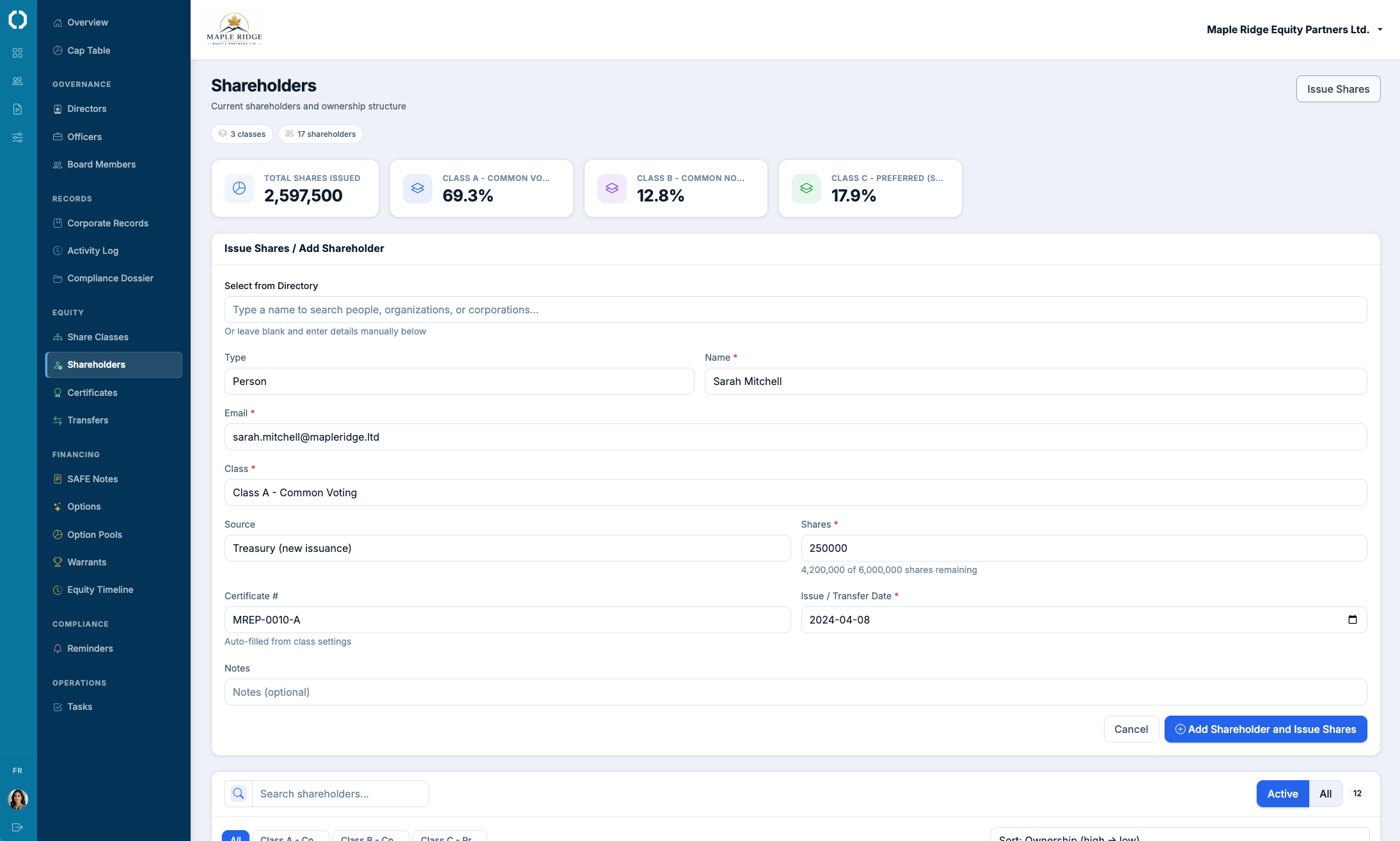
Octelligence handles NBBCA specifics in the share register, certificates, board resolutions, and beneficial-ownership filings: jurisdiction-aware templates, statute citations on each record, and the right reconciliation cadence for the corporation.
See Digital Corporate RecordsCommon questions in New Brunswick
Octelligence handles NBBCA-specific share issuance: register, certificates, resolutions, and beneficial-ownership records aligned with statute.