How to issue shares in Ontario corporations
OBCA is the Ontario corporate-law statute, governing Ontario-incorporated corporations. OBCA closely tracks the CBCA with provincial-specific variations: it has its own transparency register requirement (s. 140.2, modelled on but distinct from CBCA s. 21.1) and provincial filing channel.
| OBCA s. 23 | Issuance of shares |
|---|---|
| OBCA s. 24 | Consideration for shares |
| OBCA s. 26 | Stated capital account |
| OBCA s. 56 | Form of share certificates |
| OBCA s. 140 | Securities register |
| OBCA s. 140.2 | Transparency register (Individuals with Significant Control) |
- Authorized by the board under OBCA s. 23; consideration under s. 24
- Future services and promissory notes not permitted (s. 24(3))
- Stated capital account required under s. 26
- Securities register required under s. 140; transparency register under s. 140.2
- NI 45-106 exemption (NI passport accepted) and Form 45-106F1 filing with OSC
Board authorization under OBCA s. 23
Stock issuance is authorized by the directors under OBCA s. 23. The directors determine the consideration under s. 24. Like the CBCA, the OBCA requires consideration to be money, property, or past services; future services and promissory notes are not permitted. The directors' determination of consideration value is conclusive absent fraud.
Consideration restrictions under s. 24(3)
OBCA s. 24(3) prohibits issuance for future services or promissory notes. This mirrors CBCA s. 25(3). Ontario founder grants must rely on past services or nominal cash, with the consideration recital documenting the basis. The strict rule is consistent across Canadian federal and Ontario provincial law and differs from US Model Business Corporation Act states.
Stated capital under OBCA s. 26
OBCA s. 26 requires a separate stated capital account for each class. Stated capital tracks the paid-up consideration and is the basis for tax (ITA paid-up capital), dividend and redemption solvency tests, and shareholder distributions. The OBCA framework is essentially identical to the CBCA on this point.
Securities register and transparency register under ss. 140 and 140.2
OBCA s. 140 requires the corporation to maintain a securities register listing every shareholder. OBCA s. 140.2 (effective January 2023) requires every Ontario-incorporated private corporation to maintain a separate transparency register of Individuals with Significant Control, modelled on CBCA s. 21.1 but with Ontario-specific variations. The transparency register is internal; a portion is filed with the Ontario Business Registry.
Securities-law compliance: NI 45-106 and OSC filings
Ontario applies National Instrument 45-106 (passport regime). The most common exemptions are accredited investor, family/friends/business associates, and the offering memorandum exemption (more permissive in Ontario than in some other provinces). Form 45-106F1 is filed with the Ontario Securities Commission within 10 days of distribution closing. The Ontario OM exemption (§ 2.9) is widely used for small-to-mid Ontario private placements.
Common mistakes
Common OBCA failure points in share issuance:
- Issuing shares for future services or promissory notes (prohibited under OBCA s. 24(3))
- Not maintaining the OBCA s. 140.2 transparency register since January 2023
- Failing to file Form 45-106F1 with the OSC within 10 days of distribution
- Confusing OBCA director residency rules with CBCA's (OBCA has no residency requirement since July 2021)
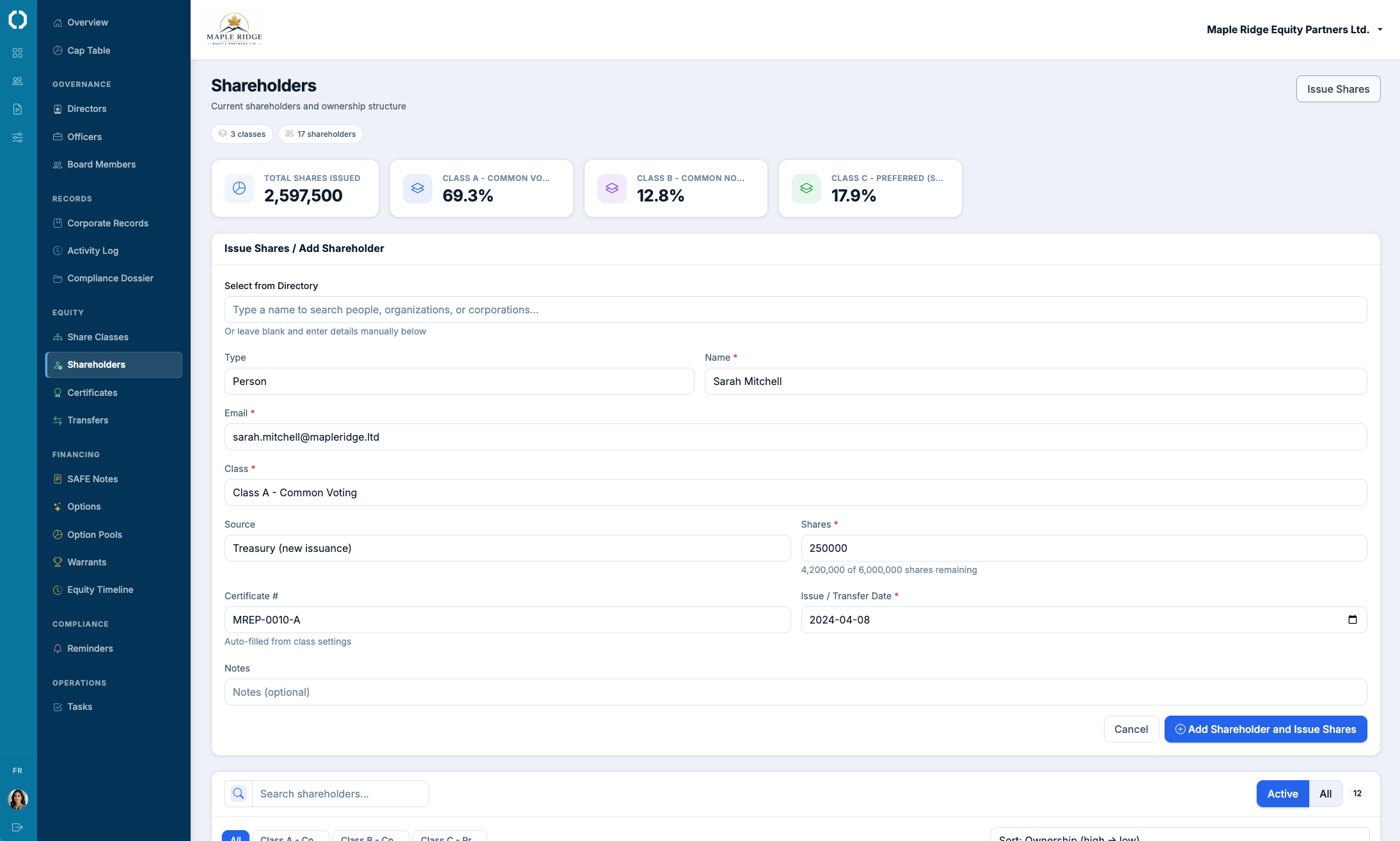
Octelligence handles OBCA specifics in the share register, certificates, board resolutions, and beneficial-ownership filings: jurisdiction-aware templates, statute citations on each record, and the right reconciliation cadence for the corporation.
See Digital Corporate RecordsCommon questions in Ontario
Octelligence handles OBCA-specific share issuance: register, certificates, resolutions, and beneficial-ownership records aligned with statute.