How to file an annual return in Alberta
Alberta's annual return under ABCA s. 162 is filed 1 month after the corporation's anniversary date through the Alberta Corporate Registry. Filings are made through Service Alberta agents (private corporate services firms). The post-2022 reforms added an ISC register filing obligation under s. 21.1 (effective May 2022). Administrative dissolution under s. 212 follows 2 consecutive years of non-filing.
| Form | Annual Return |
|---|---|
| Registrar | Alberta Corporate Registry (via Service Alberta agents) |
| Due date | 1 month after the anniversary date |
| Fee | $40 plus service-agent fees |
| Late penalty | No direct fee; administrative dissolution after 2 years |
| Form | Annual Return |
| Registrar | Alberta Corporate Registry (via Service Alberta agents) |
| Due date | 1 month after anniversary date |
| Fee | $40 plus agent service fees |
| Late penalty | No direct fee; administrative dissolution after 2 years |
| Failure to file | Administrative dissolution under ABCA s. 212 |
- Alberta Annual Return under ABCA s. 162, filed 1 month after anniversary date
- Filed through Service Alberta agents (private corporate services firms)
- $40 base fee plus agent service fees (typical total $75 to $125)
- ISC register filing under s. 21.1 since May 2022
- Administrative dissolution under s. 212 after 2 consecutive years
Alberta's agent-mediated filing system
Unlike most other Canadian jurisdictions where annual returns can be filed directly through a government portal, Alberta requires filings through Service Alberta agents: private corporate services firms that interface with the Alberta Corporate Registry. This adds an agent service fee on top of the $40 base filing fee, typically bringing the total to $75-$125 depending on the agent. The agent-mediated approach reflects Alberta's traditional model of using private intermediaries for many provincial filings.
The post-2022 ABCA reforms
Alberta's ABCA was significantly amended in 2022 with effect May 2022. The reforms added an ISC register obligation under s. 21.1 (similar to but distinct from the CBCA's s. 21.1 ISC register), modernized record-keeping provisions, and updated several procedural requirements. The reforms reflect Alberta's catch-up to the federal and other-provincial transparency-register requirements.
The 1-month-from-anniversary deadline
Alberta's deadline of 1 month from anniversary date is shorter than the CBCA's 60-day window. Corporations incorporating in Alberta should calendar the date carefully; the short window means a missed deadline produces administrative-dissolution risk faster than under CBCA.
Administrative dissolution under s. 212
Under ABCA s. 212, the Registrar may dissolve a corporation that has failed to file its annual return for 2 consecutive years. Notice is given through the agent of record and to the registered office. Reinstatement under s. 211 is possible by filing all missed annual returns and paying reinstatement fees (typically $200 through an agent).
ISC register integration
The ISC register under ABCA s. 21.1 (effective May 2022) is kept by the corporation and is updated on every change of significant-control ownership. The ISC information is not filed with the Alberta Corporate Registry routinely (unlike the CBCA ISC where portions are filed), but the register must be available for inspection by certain authorized persons. Alberta's ISC regime is closer to BC's than to the CBCA's: registry-kept information rather than government-filed information.
Procedure
The annual-return procedure as it applies in Alberta, in seven steps:
Identify the anniversary date
The annual return is due 1 month after the anniversary date of incorporation. A corporation incorporated in October has the annual return due in November of each year.Confirm current directors against the minute book
The annual return reports current directors. Confirm against the minute book.Confirm registered office address
The registered office must be in Alberta. Confirm currency.Confirm ISC register currency
The ISC register under s. 21.1 must be current as of the filing date. While the ISC register is not filed with the Registry routinely, currency is required.Engage a Service Alberta agent for the filing
Service Alberta agents are private corporate services firms. Many law firms, accounting firms, and dedicated corporate-services companies provide the service. Engage the agent and provide the current information.Agent files annual return with Alberta Corporate Registry
The agent submits the annual return to the Alberta Corporate Registry. Pay $40 base fee plus agent service fees (typically $35 to $85). The agent issues a filing receipt.Place the filing in the minute book
The agent's filing receipt, the Registry acknowledgment, and the current ISC register are placed in the minute book under the year's annual filings.
Common mistakes
Alberta's agent-mediated system and post-2022 ISC register add complexity. Common errors:
- Relying on the agent without confirming filing acknowledgments. The corporation is responsible even when an agent is engaged.
- Missing the 1-month-from-anniversary deadline; Alberta's window is shorter than CBCA's 60 days.
- Failing to maintain the ISC register under s. 21.1; the obligation is ongoing and adds complexity to what was previously a simpler regime.
- Allowing administrative dissolution under s. 212; reinstatement is possible but is more expensive through the agent system.
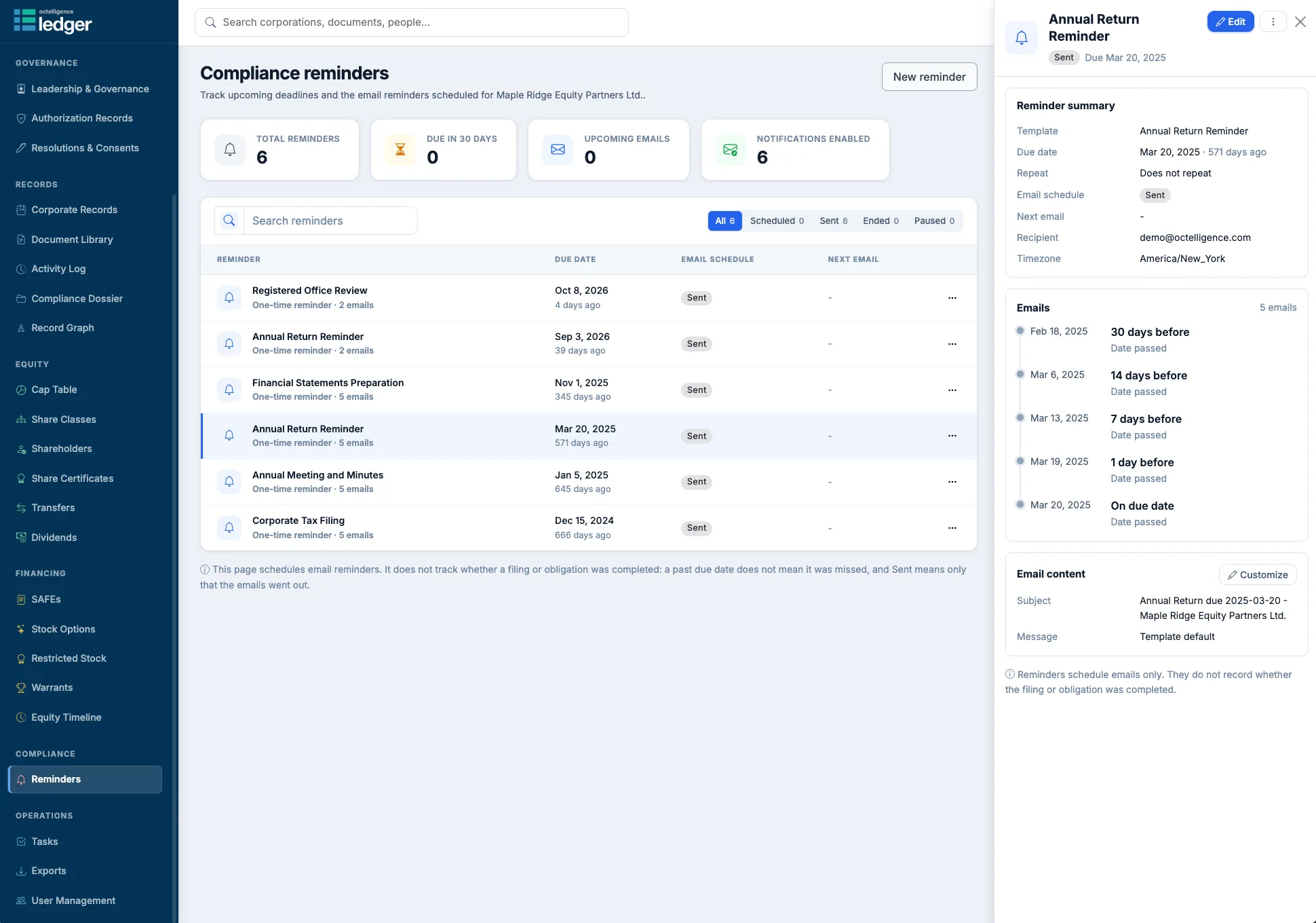
Octelligence tracks the ABCA annual-return deadline against the corporation's anniversary date or fiscal year-end, surfaces the directors, registered office, and beneficial-ownership information for the filing, and stores the filed return alongside the minute book. The jurisdiction-specific form, fee, and late-penalty rules are built in, with multi-jurisdiction portfolio views for corporations registered in more than one place.
See Digital Corporate RecordsCommon questions in Alberta
Octelligence calendars the ABCA annual-return deadline, prepares the filing against the live minute book, and stores the receipt alongside the records it confirms.