How to file an annual return in California
California requires a Statement of Information from every domestic and qualified foreign stock corporation within 90 days of incorporation and annually thereafter. The filing reports officers, directors, registered agent, and principal business address. Failure to file triggers a $250 penalty under CCC § 2204 and, more significantly, suspension of the corporation's right to do business under California Franchise Tax Board rules.
| Form | Statement of Information (Form SI-550 for stock corporations) |
|---|---|
| Registrar | California Secretary of State |
| Due date | Within 90 days of initial incorporation, then annually in the anniversary month thereafter |
| Fee | $25 filing fee |
| Late penalty | $250 (CCC § 2204) plus risk of FTB suspension |
| Form | Statement of Information (Form SI-550 stock, SI-PC professional, SI-100 nonprofit) |
| Registrar | California Secretary of State |
| Due date | Within 90 days of incorporation; annually in the anniversary month thereafter |
| Fee | $25 |
| Late penalty | $250 under CCC § 2204 |
| Failure to file | FTB suspension of corporate powers, voiding contracts and barring participation in California litigation |
- California Statement of Information (SI-550) is the annual return for stock corporations
- First filing within 90 days of incorporation; annually thereafter in the anniversary month
- $25 filing fee, paid to the Secretary of State
- Late filing triggers $250 penalty under CCC § 2204
- FTB suspension is the operational risk: a suspended corporation cannot bring suit, defend itself, or sign valid contracts in California
California's Statement of Information regime
California requires every stock corporation, professional corporation, nonprofit, LLC, and qualified foreign entity to file a Statement of Information with the Secretary of State. For stock corporations, the form is SI-550. The filing reports the corporation's officers, directors, registered agent for service of process, principal business address (street, not P.O. box), and (optionally) email address. Updates are filed mid-year if material information changes.
The 90-day initial filing window
A newly-incorporated California corporation must file its first Statement of Information within 90 days of the certificate of incorporation. Many founders miss this. The 90-day window is in addition to the annual obligation; the initial filing is independent of the anniversary-month cycle.
Anniversary-month annual filings
After the initial filing, subsequent Statements of Information are due annually in the anniversary month of incorporation. The Secretary of State sends a reminder notice 90 days before the due date to the registered agent. The filing is electronic through bizfileOnline.
FTB suspension is the operational consequence
The $250 penalty under CCC § 2204 is the direct cost of a late filing. The operationally significant consequence is FTB suspension. The Franchise Tax Board coordinates with the Secretary of State, and after a period of non-filing or non-payment, suspends the corporation's right to do business. A suspended corporation cannot bring suit, defend itself in court (other than a motion to vacate the suspension), or sign valid contracts in California. Revival requires both a new Statement of Information filing and payment of all outstanding franchise taxes plus penalties.
Reconciliation to the minute book and the cap table
The Statement of Information reports officer and director information, which must match the corporation's actual officers and directors as elected by the board and shareholders. The minute book records the board and shareholder elections; the filing reflects those elections. Discrepancies (an officer who has resigned but appears on the filing, or a director who is on the filing but not on the minute book) are red flags for diligence and may produce regulatory questions.
Procedure
The annual-return procedure as it applies in California, in seven steps:
Confirm current officers and directors against the minute book
The Statement of Information reports the corporation's actual officers (CEO/president, secretary, CFO/treasurer, plus any additional) and directors as of the filing date. Confirm against the minute book that these match the current elected positions. Any discrepancy is corrected by board or shareholder action before the filing, not by the filing itself.Confirm registered agent for service of process
California requires a registered agent (a California resident or a registered corporate agent) with a physical street address in California. Confirm the agent has not resigned and that the address is current.Determine the filing window
First Statement of Information: within 90 days of incorporation. Subsequent: annually in the anniversary month of incorporation. The Secretary of State sends a courtesy reminder; do not rely on it as the system of record.File the Statement of Information via bizfileOnline
California's bizfileOnline portal handles SI-550 filings electronically. Login with the corporation's entity number, complete officer/director/registered-agent fields, pay $25 by credit card or ACH. The portal issues a filing acknowledgment immediately.Update the FTB account if needed
If the corporation's franchise-tax status has changed, ensure FTB records reflect current officers (they share data with the Secretary of State but discrepancies can persist). Pay any outstanding minimum franchise tax ($800 annually for California corporations) at the same cycle to avoid suspension.File a mid-year amendment if material information changes
If an officer or director changes, or the principal address changes, file an amended Statement of Information at the time of change rather than waiting for the next annual cycle. The filing fee remains $25.Place the filing in the minute book
The filed Statement of Information and the receipt are placed in the minute book under the year's annual filings section. Note the bizfileOnline reference and the next annual due date.
Common mistakes
California's regime has more moving parts than most US states because the FTB coordination creates a parallel obligation. Common errors:
- Missing the 90-day initial filing window after incorporation. Founders often focus on operational setup and miss this.
- Confusing the Statement of Information with the federal annual return or the California franchise tax return; all three are distinct obligations.
- Failing to file the annual Statement of Information and triggering FTB suspension, which has operational consequences far worse than the $250 penalty.
- Filing the Statement of Information but failing to pay the $800 annual minimum franchise tax; the FTB will still suspend for tax non-payment even if SI filings are current.
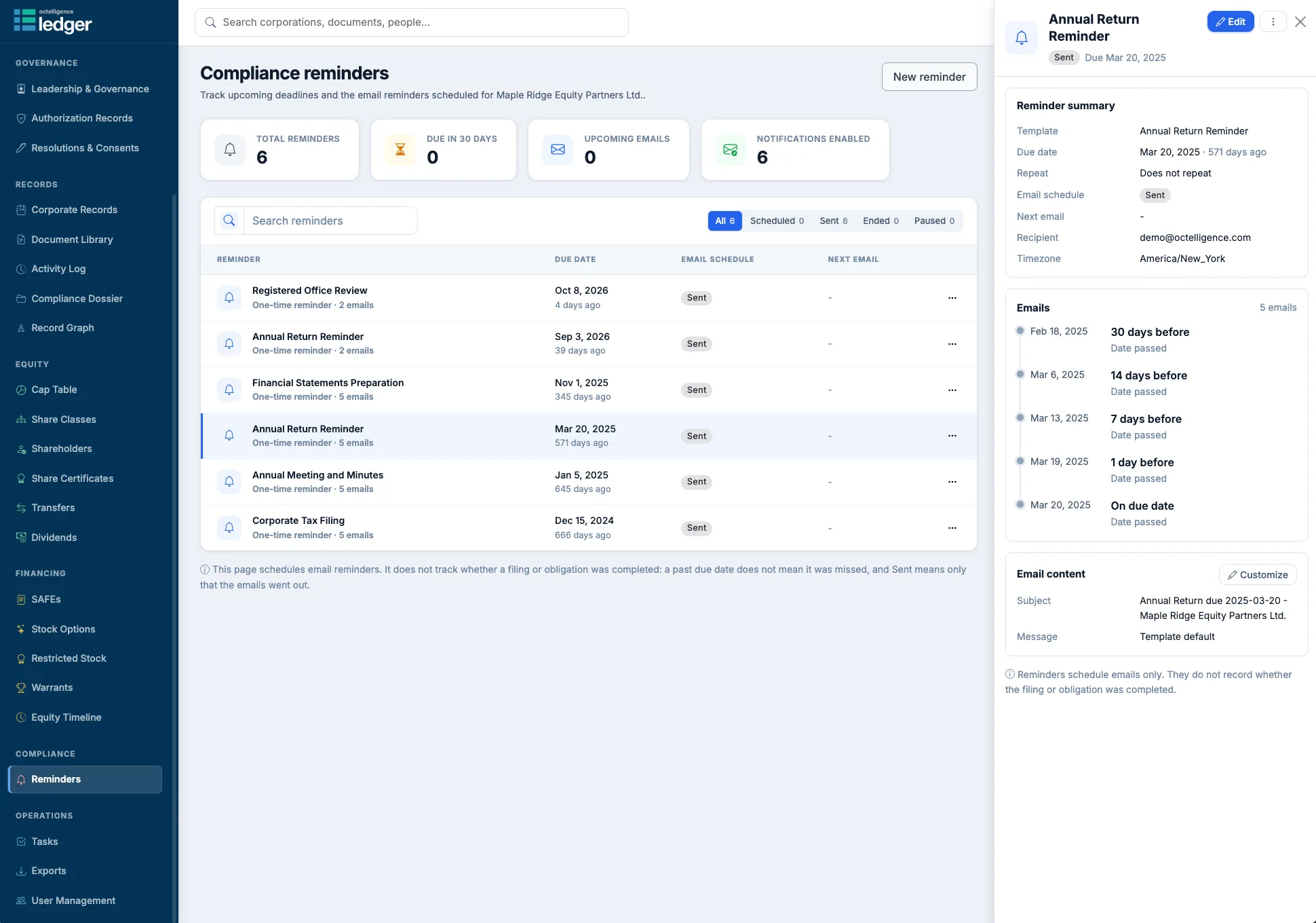
Octelligence tracks the CCC annual-return deadline against the corporation's anniversary date or fiscal year-end, surfaces the directors, registered office, and beneficial-ownership information for the filing, and stores the filed return alongside the minute book. The jurisdiction-specific form, fee, and late-penalty rules are built in, with multi-jurisdiction portfolio views for corporations registered in more than one place.
See Digital Corporate RecordsCommon questions in California
Octelligence calendars the CCC annual-return deadline, prepares the filing against the live minute book, and stores the receipt alongside the records it confirms.