How to file an annual return in Massachusetts
Massachusetts requires a simple Annual Report under M.G.L. c. 156D § 16.22, due within 2.5 months of the corporation's fiscal year-end (typically March 15 for calendar-year corporations). The $125 fee is on the higher side. Administrative dissolution under § 14.21 follows 60 days past due, with a strict reinstatement process. The Business Litigation Session of the Suffolk Superior Court hears reinstatement disputes for complex matters.
| Form | Annual Report |
|---|---|
| Registrar | Massachusetts Secretary of the Commonwealth, Corporations Division |
| Due date | Within 2.5 months of the corporation's fiscal year-end |
| Fee | $125 for-profit corporation |
| Late penalty | Administrative dissolution after 60 days past due |
| Form | Annual Report |
| Registrar | Massachusetts Secretary of the Commonwealth, Corporations Division |
| Due date | Within 2.5 months of fiscal year-end |
| Fee | $125 |
| Late penalty | Administrative dissolution after 60 days past due |
| Failure to file | Administrative dissolution under M.G.L. c. 156D § 14.21 |
- Massachusetts Annual Report under M.G.L. c. 156D § 16.22
- Due within 2.5 months of fiscal year-end (typically March 15 for calendar-year corps)
- $125 filing fee for for-profit corporations
- Administrative dissolution after 60 days past due under § 14.21
- Business Litigation Session of Suffolk Superior Court hears complex reinstatement disputes
The Massachusetts fiscal-year cadence
Massachusetts is one of few states that tie the Annual Report to fiscal year rather than calendar year or anniversary month. The Annual Report is due within 2.5 months of fiscal year-end. For most calendar-year corporations, this means March 15. For fiscal-year corporations, the date varies. This is consistent with Massachusetts's emphasis on financial and tax-year alignment.
The MBCA-MA framework
Massachusetts adopted the Model Business Corporation Act with state-specific modifications in 2004 (codified as M.G.L. c. 156D). The Annual Report obligation under § 16.22 follows the MBCA pattern: officers, directors, registered agent, principal office, and stock-issuance information. The filing is electronic through the Corporations Division portal.
$125 fee and the administrative dissolution mechanism
The $125 filing fee is on the higher side among priority states. Massachusetts does not have a separate late-fee penalty (unlike Florida's $400); instead, the consequence of non-filing is administrative dissolution after 60 days. This is a more abrupt mechanism than the gradual penalty-then-dissolution approach used by other states.
Administrative dissolution under § 14.21
The Secretary of the Commonwealth may administratively dissolve a corporation under M.G.L. c. 156D § 14.21 if the corporation has failed to file its Annual Report 60 days past the due date, failed to pay franchise tax or other state obligations, or failed to maintain a registered agent. Notice is sent to the registered agent before dissolution. Reinstatement under § 14.22 is possible within 5 years by filing missed Annual Reports and paying $100 reinstatement fee.
The Business Litigation Session
The Suffolk Superior Court Business Litigation Session is the specialized court that hears complex corporate-governance disputes, including disputes over administrative dissolution and reinstatement. For matters involving multiple jurisdictions or sophisticated corporate structures, the BLS provides a forum with judges experienced in MBCA-MA interpretation.
Procedure
The annual-return procedure as it applies in Massachusetts, in seven steps:
Confirm fiscal year-end
The corporation's fiscal year-end is set in its articles of incorporation or bylaws. For most calendar-year corporations, fiscal year-end is December 31 and the Annual Report is due by March 15. For fiscal-year corporations, the date varies.Confirm officers, directors, registered agent
Match against the minute book. The Annual Report lists the president, treasurer, secretary, and clerk (Massachusetts uses both "secretary" and "clerk" titles), plus directors and registered agent.Confirm authorized and issued stock
The Annual Report reports authorized and issued shares by class. Confirm against the share register and cap table.Login to Corporations Division online portal
The Massachusetts Corporations Division portal at corp.sec.state.ma.us is the filing system. Login with the corporation's identification number.Complete the Annual Report
Enter officer/director/registered-agent details, principal office address, authorized and issued stock, and any optional contact information. Pay $125 by credit card.Verify filing acceptance
The system issues an immediate filing confirmation. Retain the confirmation.Place the filing in the minute book
The filed Annual Report and confirmation are placed in the minute book under the year's annual filings. Note the next due date (2.5 months from next fiscal year-end).
Common mistakes
Massachusetts's fiscal-year-tied schedule and abrupt administrative-dissolution mechanism trip up corporations from other states. Common errors:
- Assuming a calendar-year deadline (March 1, April 1) instead of the fiscal-year-tied 2.5-month-from-year-end deadline.
- Failing to identify the correct fiscal year-end (the articles control; the bylaws may indicate a different year-end for record-keeping purposes).
- Missing the 60-day grace period before administrative dissolution. Massachusetts is faster to dissolve than many states.
- Not coordinating the Annual Report with the federal income tax filing and Massachusetts corporate excise tax cycle.
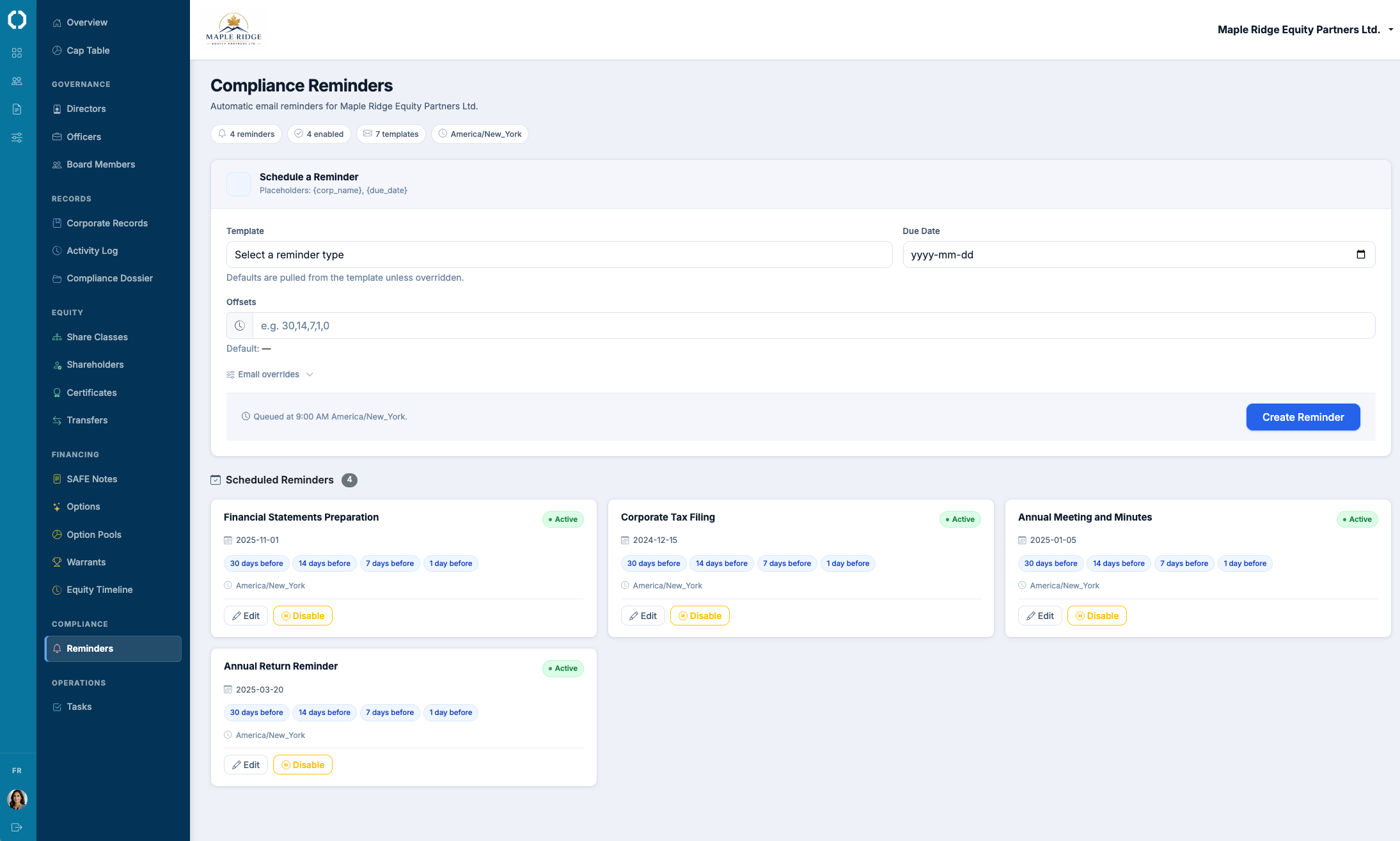
Octelligence tracks the M.G.L. c. 156D annual-return deadline against the corporation's anniversary date or fiscal year-end, surfaces the directors, registered office, and beneficial-ownership information for the filing, and stores the filed return alongside the minute book. The jurisdiction-specific form, fee, and late-penalty rules are built in, with multi-jurisdiction portfolio views for corporations registered in more than one place.
See Digital Corporate RecordsCommon questions in Massachusetts
Octelligence calendars the M.G.L. c. 156D annual-return deadline, prepares the filing against the live minute book, and stores the receipt alongside the records it confirms.