How to file an annual return in Texas
Texas consolidates the corporate annual return into the franchise tax filing system administered by the Comptroller, not the Secretary of State. The Public Information Report (PIR, Form 05-102) is filed annually together with the franchise tax report by May 15. Corporations below the no-tax-due threshold ($1.23M total revenue for 2024 to 2025 reports) file a No Tax Due Information Report. Forfeiture of corporate privileges under TTC § 171.251 is the consequence of extended non-compliance.
| Form | Public Information Report (Form 05-102) and Franchise Tax Report |
|---|---|
| Registrar | Texas Comptroller of Public Accounts (filings consolidated through the Comptroller, not the Secretary of State) |
| Due date | May 15 annually |
| Fee | No direct PIR filing fee; franchise tax owed if total revenue exceeds the no-tax-due threshold ($1.23 million for 2024 to 2025 reports, indexed) |
| Late penalty | 5% then 10% of unpaid franchise tax; eventually forfeiture of corporate privileges under TTC § 171.251 |
| Form | Public Information Report (Form 05-102) plus Franchise Tax Report |
| Registrar | Texas Comptroller of Public Accounts (consolidated annual filing system) |
| Due date | May 15 annually |
| Fee | No PIR fee; franchise tax owed only if total revenue exceeds the no-tax-due threshold |
| Late penalty | 5% then 10% of unpaid franchise tax; ultimately forfeiture of corporate privileges |
| Failure to file | Forfeiture under TTC § 171.251; loss of right to sue or defend in Texas courts |
- Texas consolidates corporate annual return with franchise tax: PIR (Form 05-102) plus franchise tax report
- Filed with the Comptroller, not the Secretary of State (unusual among US states)
- May 15 annual deadline
- No-tax-due threshold $1.23 million total revenue (2024 to 2025 reports); below threshold the corporation files No Tax Due Information Report
- Forfeiture of corporate privileges under TTC § 171.251 is the operational risk
The Texas consolidated filing system
Unlike most US states where the annual return is filed with the Secretary of State, Texas consolidates the corporate annual return into the franchise tax filing system administered by the Comptroller of Public Accounts. The Public Information Report (PIR, Form 05-102) is filed alongside the franchise tax report by May 15 each year. This consolidation reflects Texas's preference for revenue-side enforcement of corporate compliance.
The no-tax-due threshold
Texas franchise tax is owed only if the corporation's total revenue exceeds an indexed threshold ($1.23 million for 2024 to 2025 reports). Below the threshold, the corporation files a No Tax Due Information Report (no franchise tax owed, but the filing is still required). Above the threshold, the corporation computes franchise tax under the appropriate margin formula (cost of goods, compensation, EZ method, or total revenue minus a fixed amount, with the lowest result selected).
What the PIR reports
The Public Information Report lists the corporation's officers and directors (with addresses), the principal office address, the registered agent and registered office, and the entity's organizational structure. The PIR is public information once filed and is searchable through the Comptroller's website.
Forfeiture of corporate privileges
Failure to file the PIR or pay franchise tax leads to forfeiture of corporate privileges under TTC § 171.251. A corporation that has forfeited its privileges cannot maintain or defend a lawsuit in Texas courts (other than to contest the forfeiture itself), and any officer or director who acts on behalf of the corporation during forfeiture may be personally liable for corporate obligations under TTC § 171.252. Revival requires filing all back PIRs and franchise tax reports plus paying penalties.
The 2024 Texas Business Court factor
The Texas Business Court, operational since September 2024, hears disputes about corporate annual-return forfeiture and revival proceedings when the amount in dispute exceeds the jurisdictional threshold. Practitioners increasingly file revival motions through the Business Court for sophisticated multi-jurisdictional corporate matters.
Procedure
The annual-return procedure as it applies in Texas, in seven steps:
Determine if total revenue exceeds the no-tax-due threshold
Calculate the corporation's total revenue for the fiscal year ending in the calendar year preceding the report year. If total revenue is at or below $1.23 million (2024 to 2025 reports), the corporation files the No Tax Due Information Report. If above, it computes franchise tax under the applicable margin formula.Compute franchise tax (if owed)
If the corporation owes franchise tax, compute under each available margin formula (total revenue minus $1.23 million; or total revenue minus cost of goods sold; or total revenue minus compensation; or 70% of total revenue, whichever is lowest) and select the lowest. The current rates are 0.375% retail/wholesale; 0.75% other. The EZ method is available for some smaller corporations.Complete the Public Information Report (Form 05-102)
List officers (CEO, secretary, treasurer or equivalent), directors, principal office, registered agent. Match the listing to the corporation's actual current positions per the minute book.File electronically through Comptroller WebFile
Login to webfile.cpa.state.tx.us. File both the PIR and the franchise tax report (or No Tax Due Information Report) electronically by May 15. Pay franchise tax owed by ACH or credit card.Confirm registration with the Secretary of State if needed
If the corporation has changed registered agent or registered office, file the change with the Secretary of State separately under TBOC § 5.201. The PIR reports the current state but does not effect the change.Verify good standing through Comptroller and Secretary of State
Both agencies maintain good-standing records. After the PIR/franchise tax filing, confirm the corporation's status as "current" with the Comptroller and "in good standing" with the Secretary of State.Place the filing in the minute book
The filed PIR, the franchise tax report or No Tax Due Information Report, the payment receipt (if applicable), and the Comptroller's filing acknowledgment are placed in the minute book under the year's annual filings.
Common mistakes
Texas's consolidated system trips up corporations used to Secretary-of-State annual returns. Common errors:
- Filing with the Secretary of State instead of the Comptroller. Texas's annual return is filed with the Comptroller; Secretary of State filings are for entity-formation and amendment matters.
- Failing to file the PIR when below the no-tax-due threshold. The threshold removes the tax obligation, not the filing obligation; the No Tax Due Information Report must still be filed.
- Computing franchise tax under only one margin formula without comparing. The lowest result wins under TTC § 171.101(a); a corporation may save significantly by selecting the optimal formula.
- Operating during a forfeiture period without revival; officers and directors may be personally liable for corporate obligations during forfeiture under TTC § 171.252.
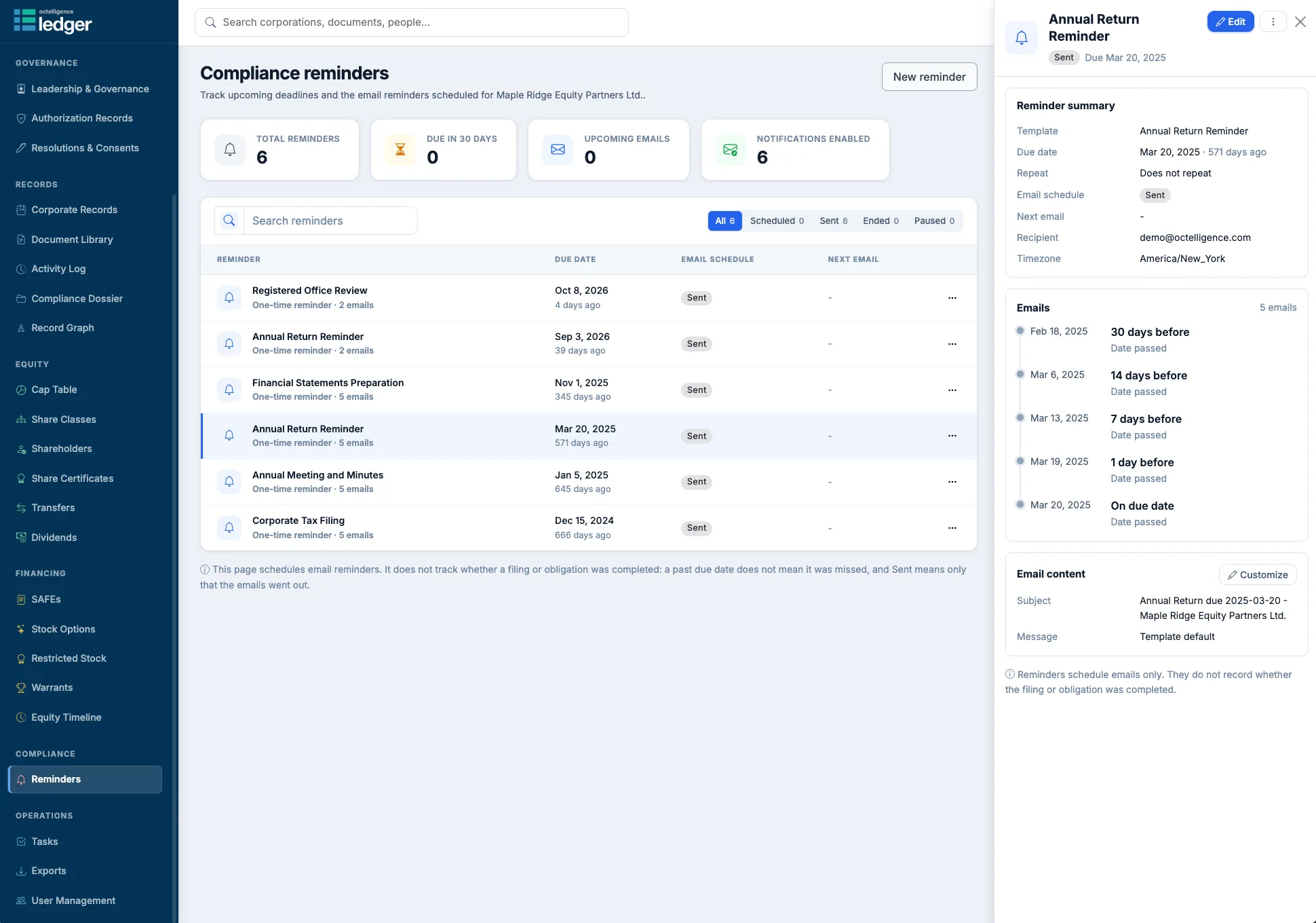
Octelligence tracks the TBOC annual-return deadline against the corporation's anniversary date or fiscal year-end, surfaces the directors, registered office, and beneficial-ownership information for the filing, and stores the filed return alongside the minute book. The jurisdiction-specific form, fee, and late-penalty rules are built in, with multi-jurisdiction portfolio views for corporations registered in more than one place.
See Digital Corporate RecordsCommon questions in Texas
Octelligence calendars the TBOC annual-return deadline, prepares the filing against the live minute book, and stores the receipt alongside the records it confirms.