How to file an annual return in New York
New York is one of few US states with a biennial (not annual) return cadence. The Biennial Statement under NY BCL § 408 reports the corporation's CEO and principal business address every two years in the anniversary month. The $9 fee makes it the cheapest annual-cycle filing among priority US states, but currency of the filing remains operationally important because process service depends on registered-agent currency.
| Form | Biennial Statement |
|---|---|
| Registrar | New York Department of State, Division of Corporations |
| Due date | Every two years in the calendar month of incorporation |
| Fee | $9 |
| Late penalty | No direct fee; status flagged as past-due |
| Form | Biennial Statement |
| Registrar | NY Department of State, Division of Corporations |
| Due date | Every two years in the calendar month of original incorporation |
| Fee | $9 |
| Late penalty | No statutory fee; status becomes past-due |
| Failure to file | Eventual proclamation of dissolution by the Secretary of State after extended non-filing |
- New York uses biennial cadence: filings every two years, not annually
- Filed under NY BCL § 408 with the Department of State
- Due in the calendar month of the corporation's original incorporation
- $9 filing fee (the lowest among priority US states)
- Failure to file does not trigger immediate penalty but leaves the corporation past-due
New York's biennial cadence
New York is one of few US jurisdictions with a biennial (every two years) annual-return cadence. The corporation files a Biennial Statement under NY BCL § 408 in the calendar month of its original incorporation, every two years. New York is unusual in that the cadence is purely informational: the filing reports the CEO and principal address; it does not include franchise tax computation (which is a separate Department of Taxation filing) or detailed officer/director information.
What the Biennial Statement reports
The filing reports the corporation's CEO name and business address, and the principal executive office address. It does not require listing all officers or directors. The registered agent for service of process is updated separately under NY BCL § 305 if it changes; the Biennial Statement does not re-confirm the registered agent.
The $9 filing fee
At $9, New York's Biennial Statement is the cheapest annual-cycle filing among priority US jurisdictions. The fee has been at $9 for decades and is widely noted as a token charge rather than a revenue obligation. The low fee is consistent with New York's view that the filing is purely informational.
Late filings and dissolution by proclamation
New York does not impose a direct late-filing fee for missing the Biennial Statement. The corporation is flagged as past-due in the Department of State's record. After extended non-filing, the Secretary of State may dissolve the corporation by proclamation under NY BCL § 1006-a (a process used selectively). Revival requires filing the missed statements plus a revival filing fee.
Coordination with the New York franchise tax
The Biennial Statement is separate from the New York franchise tax. The Department of Taxation administers the franchise tax (filed annually with the corporate tax return). Failure to file the franchise tax has separate consequences (interest, penalties, eventual cancellation of authority to do business) that operate in parallel to the Department of State's Biennial Statement system.
Procedure
The annual-return procedure as it applies in New York, in seven steps:
Identify the corporation's biennial filing year
If the corporation was incorporated in 2024, the first Biennial Statement is due in 2026 (the month of incorporation). The cycle is two years from each prior Biennial Statement. Confirm the calendar by checking the corporation's record on the NY Department of State business search.Confirm the CEO name and principal executive office address
The Biennial Statement reports the CEO name and principal executive office address. Confirm against the current minute book that the CEO is correctly named (the position elected by the board) and that the principal executive office is current.Confirm the registered agent under BCL § 305
The registered agent for service of process is separately reported under BCL § 305 (designation of the Secretary of State as agent and the post-office address). Confirm currency; if the address has changed, file a § 305 update.File the Biennial Statement online through NYS DOS
The NY Department of State has an online Biennial Statement system at dos.ny.gov. Provide the DOS ID, the CEO name and address, and the principal executive office. Pay $9 by credit card.Confirm the filing acknowledgment
The system generates a confirmation immediately. Retain the filing acknowledgment in the minute book.Coordinate with annual NY franchise tax filing
The corporation's NY franchise tax (Form CT-3 or CT-3-S) is filed separately and annually with the NY Department of Taxation. Confirm that this filing is current, as the Biennial Statement does not address franchise tax obligations.Place the filing in the minute book
The Biennial Statement filing receipt is placed in the minute book under the year's annual filings section. Note the next biennial due date (two years from filing date) so the next cycle is not missed.
Common mistakes
New York's biennial cadence is an unusual schedule that founders often miss. Common errors:
- Treating the Biennial Statement as an annual obligation. The corporation may file annually if it wants to (no harm in early filing), but the actual obligation is every two years.
- Confusing the Biennial Statement with the NY franchise tax. They are filed with different agencies (Department of State vs Department of Taxation) and serve different purposes.
- Reporting outdated officer or registered-agent information; service of process problems result if the registered agent record is stale.
- Missing the dissolution by proclamation window. Once proclaimed, revival requires more paperwork and fees than the $9 Biennial Statement would have cost.
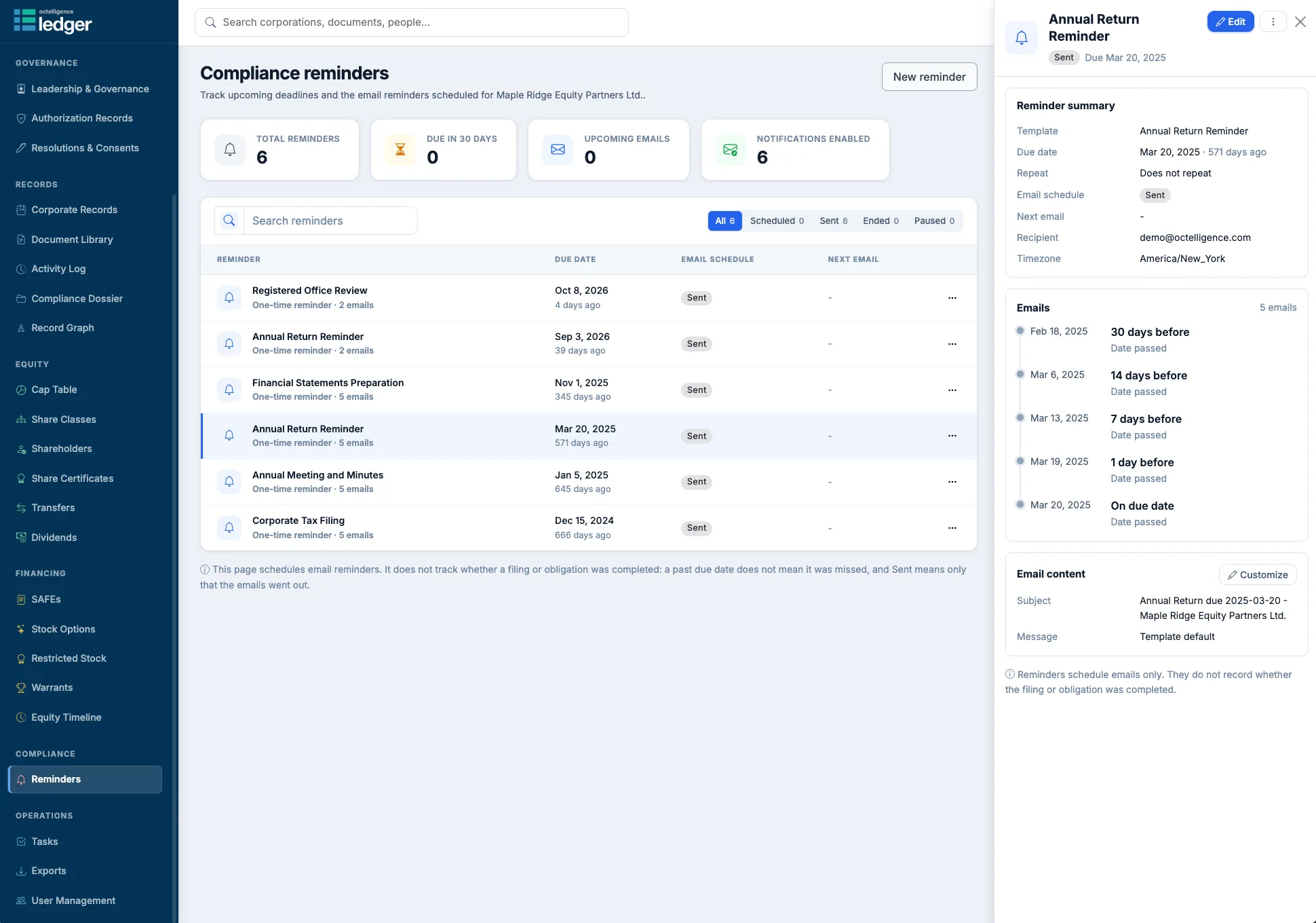
Octelligence tracks the NY BCL annual-return deadline against the corporation's anniversary date or fiscal year-end, surfaces the directors, registered office, and beneficial-ownership information for the filing, and stores the filed return alongside the minute book. The jurisdiction-specific form, fee, and late-penalty rules are built in, with multi-jurisdiction portfolio views for corporations registered in more than one place.
See Digital Corporate RecordsCommon questions in New York
Octelligence calendars the NY BCL annual-return deadline, prepares the filing against the live minute book, and stores the receipt alongside the records it confirms.