How to file an annual return in Florida
Florida's annual report under FBCA § 607.1622 is due May 1 each year. The filing reports officers, directors, registered agent, and principal address, with a $150 filing fee for for-profit corporations. The $400 late penalty under FBCA § 607.193 is one of the higher US late fees. Administrative dissolution under § 607.1421 follows extended non-compliance, with reinstatement possible up to one year after dissolution.
| Form | Annual Report |
|---|---|
| Registrar | Florida Department of State, Division of Corporations (Sunbiz) |
| Due date | May 1 annually |
| Fee | $150 for-profit corporation |
| Late penalty | $400 (FBCA § 607.193) |
| Form | Annual Report (Sunbiz) |
| Registrar | Florida Department of State, Division of Corporations |
| Due date | May 1 annually |
| Fee | $150 for-profit corporation |
| Late penalty | $400 under FBCA § 607.193 |
| Failure to file | Administrative dissolution under FBCA § 607.1421 after September 1 grace period |
- Florida annual report filed under FBCA § 607.1622 by May 1
- Filed with the Department of State Division of Corporations via Sunbiz
- $150 filing fee for for-profit corporations
- $400 late penalty under FBCA § 607.193 (one of the highest US late fees)
- Administrative dissolution under FBCA § 607.1421 after non-filing past September 1
Florida's Sunbiz system
Florida's annual report is filed through the Department of State's Sunbiz portal, which serves as both the filing system and the public corporate registry. The system handles annual reports, amendments, and most corporate filings. Florida's filing volume is among the highest in the US (in part because of the state's popularity for snowbird incorporations and personal-asset planning structures).
May 1 deadline and the $400 penalty
All for-profit corporations file by May 1 each year. The $150 fee is on the higher side for state annual returns but not unusual. What is unusual is the $400 late penalty under FBCA § 607.193: one of the highest direct late-filing penalties among priority US jurisdictions. The penalty is automatic on filings after May 1.
What the annual report covers
The annual report lists the corporation's officers (president, vice-president, secretary, treasurer, and any additional officers), directors, registered agent and registered office, and principal address. It does not include franchise tax computation; Florida has no state-level corporate income tax for ordinary income, though there is a corporate income tax on net income from Florida sources under § 220 of the Florida statutes.
Administrative dissolution under § 607.1421
Failure to file the annual report by September 1 (a 4-month grace period after the May 1 due date) triggers administrative dissolution under FBCA § 607.1421. The Department of State sends notice of administrative dissolution to the registered agent. Reinstatement is possible up to one year after dissolution by filing the missed annual reports and paying reinstatement fees ($600 plus the missed annual report fees plus penalties).
Reconciliation to the minute book
The annual report reflects officers and directors as elected by the board and shareholders per the minute book. Any change of officer or director that occurred during the year should be reflected in the annual report. Florida is one of few states that requires both officers and directors with full address information in the annual report.
Procedure
The annual-return procedure as it applies in Florida, in seven steps:
Confirm officers, directors, registered agent against the minute book
Pull the most recent board minutes and shareholder consents. Confirm the current officers (president, vice-president, secretary, treasurer, any additional), the current board of directors, the registered agent, and the registered office. The annual report reflects this state.Verify principal address
The annual report requires the principal business address. Confirm the address is current. If the principal address has changed, the change is effected by the annual-report filing.Login to Sunbiz and locate the corporation
The Sunbiz portal at sunbiz.org has an Annual Report system. Login or search by entity name or number. Florida assigns a 12-digit entity number that uniquely identifies the corporation.Complete the annual report form
Enter officer information (name, title, address for each), director information, registered agent details, principal address. The system pre-populates from the prior year's report; review and update as needed.Pay $150 by May 1
Payment by credit card or ACH. The system issues a filing receipt immediately.Note: if past May 1, expect $400 penalty
Filings between May 1 and September 1 are still accepted but the $400 penalty under FBCA § 607.193 applies. Filings after September 1 require reinstatement (more expensive and more complex).Place the filing receipt in the minute book
The filed annual report and the Sunbiz filing receipt are placed in the minute book under the year's annual filings. Note the next due date (May 1 of the following year).
Common mistakes
Florida's $400 late fee makes the May 1 deadline materially costly to miss. Common errors:
- Missing May 1 and incurring the $400 penalty. The penalty is far higher than most US states' late fees.
- Allowing administrative dissolution under FBCA § 607.1421. Once dissolved, reinstatement costs $600 plus missed report fees plus penalties.
- Filing officer or director information that does not match the minute book. Florida is a state where diligence counsel checks Sunbiz against the minute book; discrepancies are flagged.
- Confusing Florida's no-general-corporate-income-tax status with no annual return obligation. The annual report is a separate filing obligation independent of tax.
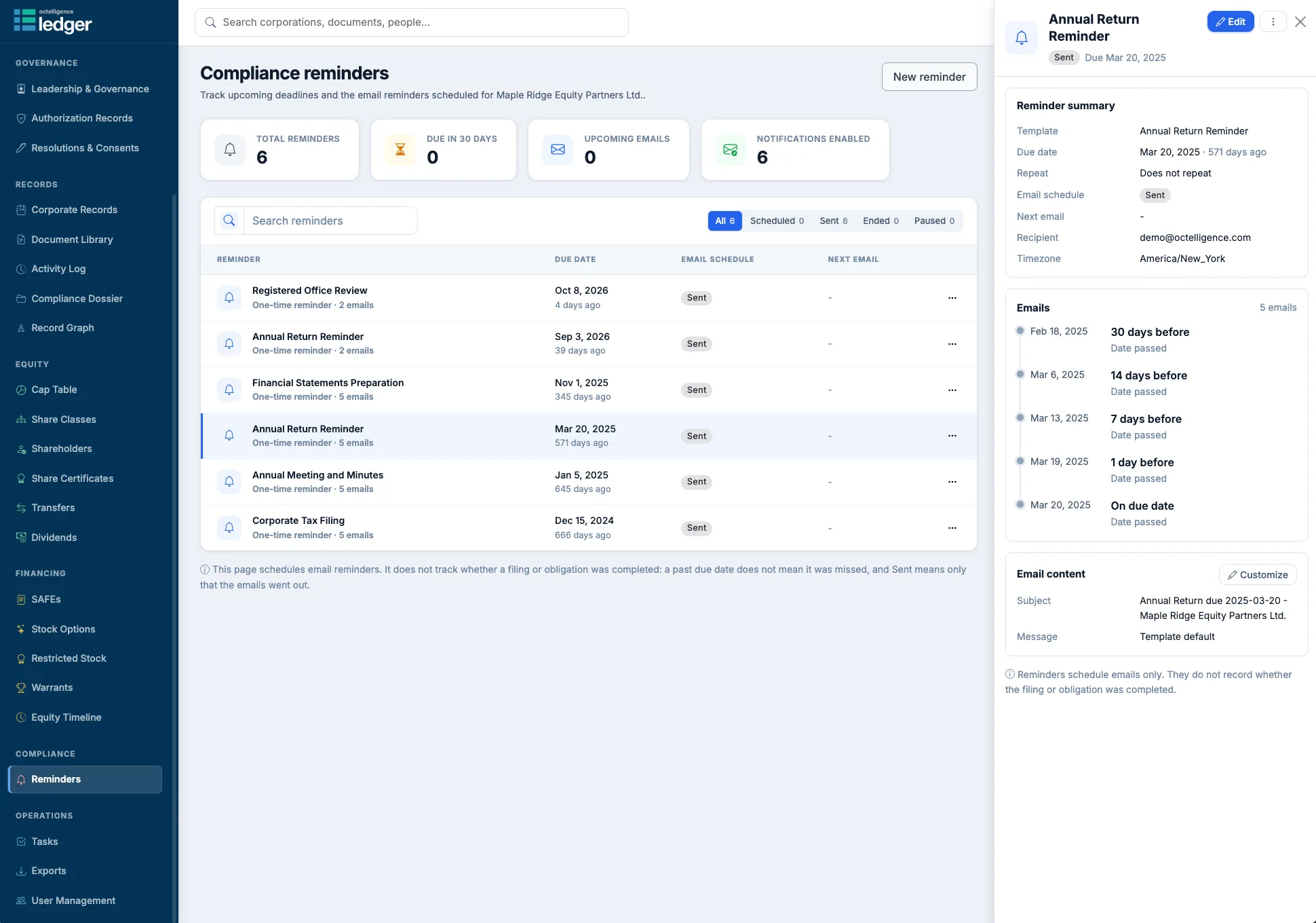
Octelligence tracks the FBCA annual-return deadline against the corporation's anniversary date or fiscal year-end, surfaces the directors, registered office, and beneficial-ownership information for the filing, and stores the filed return alongside the minute book. The jurisdiction-specific form, fee, and late-penalty rules are built in, with multi-jurisdiction portfolio views for corporations registered in more than one place.
See Digital Corporate RecordsCommon questions in Florida
Octelligence calendars the FBCA annual-return deadline, prepares the filing against the live minute book, and stores the receipt alongside the records it confirms.