How to file an annual return in Delaware
Delaware combines the corporate annual return with the franchise tax filing into a single annual obligation due March 1. The filing is electronic through the Division of Corporations' eCorp system and incorporates registered-office, registered-agent, and officer information together with the franchise tax computation. Failure to file or pay leads to loss of good standing, ineligibility to bring suit in Delaware courts, and ultimately administrative cancellation of the charter.
| Form | Annual Franchise Tax Report |
|---|---|
| Registrar | Delaware Division of Corporations |
| Due date | March 1 each year (for the prior calendar year) |
| Fee | $50 minimum filing fee, plus franchise tax ($175 minimum under the Authorized Shares method, $400 minimum under the Assumed Par Value Capital method) |
| Late penalty | $200 late filing penalty plus 1.5% monthly interest on unpaid franchise tax |
| Form | Annual Franchise Tax Report (filed via eCorp) |
| Registrar | Delaware Division of Corporations |
| Due date | March 1 annually |
| Fee | $50 filing fee + franchise tax (minimum $175 or $400 depending on method) |
| Late penalty | $200 + 1.5% monthly interest on unpaid tax |
| Failure to file | Loss of good standing under 8 Del. C. § 502; eventual charter cancellation under § 510 after non-payment of three years |
- Delaware combines the annual report with the annual franchise tax: one filing covers both
- Due March 1 of each year for the preceding calendar year
- Two methods to compute franchise tax: Authorized Shares (default, minimum $175) or Assumed Par Value Capital (often lower for cap-rich, low-asset companies)
- Late filing penalty $200, plus 1.5% monthly interest on unpaid tax
- After three consecutive years of non-payment, the charter is cancelled under 8 Del. C. § 510
The Delaware annual return is a franchise tax filing
Unlike many US states where the annual return is a simple information filing, Delaware's annual return is fundamentally a franchise tax computation. The filing reports the corporation's authorized capital structure, registered-office and registered-agent details, and officer information, then computes the franchise tax owed under one of two methods. Delaware uses the franchise tax as a primary revenue source from incorporation, which is why filing diligence is enforced aggressively.
Authorized Shares method versus Assumed Par Value Capital method
The default Authorized Shares method computes franchise tax based on the number of authorized shares: $175 minimum for 5,000 or fewer shares, scaling up with share count. The Assumed Par Value Capital method computes based on issued shares and total gross assets, often producing a lower number for venture-backed corporations with high authorized share counts but modest issued capital. Most cap-table-aware corporations select Assumed Par Value Capital for the savings; the choice is made on the filing.
Registered-agent and registered-office confirmation
The annual return confirms the corporation's registered agent and registered office in Delaware. Both must be current as of the filing. Changes during the year (resignation of registered agent, change of registered office address) are filed separately under 8 Del. C. § 132 or § 133, but the annual return is the natural point to reconcile against the current state of the register.
Penalties and the path to cancellation
A missed March 1 deadline produces an immediate $200 penalty plus 1.5% monthly interest on unpaid tax. The corporation loses good standing, which bars it from bringing suit in Delaware courts and complicates many financing and acquisition transactions. After three consecutive years of non-payment of franchise tax, the Secretary of State may proclaim the charter cancelled under 8 Del. C. § 510. Revival requires payment of all back taxes plus penalties plus a revival filing.
Reconciliation to the minute book
A copy of the filed annual return is placed in the minute book under the annual filings section, together with the franchise tax receipt and the Delaware certificate of good standing (if separately obtained). This is the record that diligence counsel will request to confirm continued legal existence of the corporation.
Procedure
The annual-return procedure as it applies in Delaware, in seven steps:
Confirm the corporation's authorized capital structure and outstanding shares
Pull the current articles, the certificate-of-amendment history, and the cap table. The annual return reports the authorized share count and structure (par-value classes if any). Material discrepancies between the report and the cap table will produce franchise tax errors.Compute franchise tax under both methods and select the lower
Run the Authorized Shares calculation and the Assumed Par Value Capital calculation. The Delaware Division of Corporations website has a calculator. Select the lower of the two on the filing; the method is selected each year independently.Confirm registered agent and registered office
The Delaware registered agent must be current and not in resignation status. The registered office address must match the registered-agent records. If the agent has resigned, file a § 132/§ 133 change before the annual return.File the Annual Franchise Tax Report via eCorp by March 1
Login to the Delaware eCorp system, select the corporation, complete the report fields, compute the tax, pay by ACH or credit card. The system produces an immediate filing receipt with a Delaware file number reference.Pay the franchise tax in full
Franchise tax is paid at filing or shortly after. Payment plans are not generally permitted for current-year tax; only back-tax revival situations may permit installments. Verify payment confirmation on eCorp.Obtain certificate of good standing if needed for downstream uses
For financings, acquisitions, foreign-registration filings, or other diligence purposes, separately request a Delaware Certificate of Good Standing through eCorp ($50 each). The certificate is valid for 90 days for most purposes.File a copy in the minute book under annual returns
Place the filed annual report, the franchise tax receipt, and any obtained certificate of good standing in the minute book under the year's annual filings section. Note the eCorp filing reference and date.
Common mistakes
The annual return is the most-missed corporate filing because the deadline is fixed and not tied to fiscal year. Common errors:
- Miscomputing franchise tax under Authorized Shares when Assumed Par Value Capital would produce a lower figure (or vice versa). The 100x cost difference is one of the most common mistakes among DIY-filing startups.
- Filing after the registered agent has resigned, producing a filing rejection. The registered-agent change must precede or accompany the annual return.
- Treating the franchise tax as deductible. Delaware franchise tax is a state tax, not a federal income tax deduction; characterize it accurately on financial statements.
- Failing to obtain a contemporaneous certificate of good standing for diligence purposes; the annual-return filing receipt is not equivalent to the certificate of good standing.
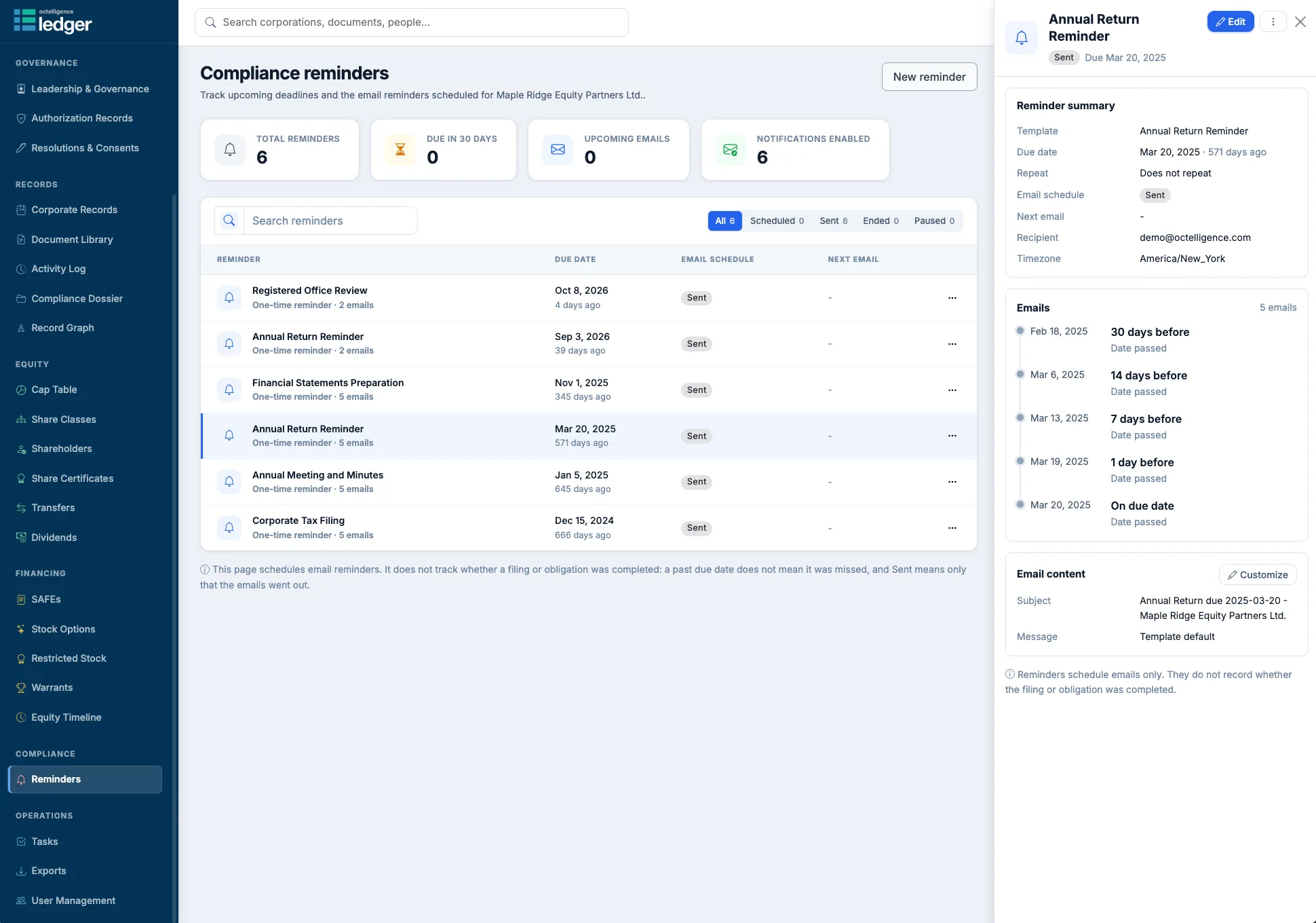
Octelligence tracks the DGCL annual-return deadline against the corporation's anniversary date or fiscal year-end, surfaces the directors, registered office, and beneficial-ownership information for the filing, and stores the filed return alongside the minute book. The jurisdiction-specific form, fee, and late-penalty rules are built in, with multi-jurisdiction portfolio views for corporations registered in more than one place.
See Digital Corporate RecordsCommon questions in Delaware
Octelligence calendars the DGCL annual-return deadline, prepares the filing against the live minute book, and stores the receipt alongside the records it confirms.