How to issue shares in Nova Scotia corporations
Nova Scotia is the distinctive Canadian incorporation jurisdiction: instead of articles of incorporation, NS uses a memorandum of association and articles of association (the UK Companies Act framework). The Companies Act (Nova Scotia) tracks UK and pre-1971 Canadian patterns rather than the modern CBCA template. This makes NS the closest Canadian analogue to UK corporate law and a sometimes-chosen jurisdiction for UK-Canada cross-border structures.
| NSCA s. 24 (Articles) | Allotment of shares (memorandum/articles framework) |
|---|---|
| NSCA Schedule I | Table A model articles for share issuance |
| NSCA s. 24 | Share certificates |
| NSCA s. 33 | Register of members |
| NSCA s. 26 | Beneficial-ownership register |
| NS Securities Act | Provincial securities-law administration via NSSC |
- NS uses memorandum/articles of association (UK-style), not articles of incorporation
- Authority to allot shares is in the articles, similar to UK CA 2006
- Consideration framework follows UK patterns more than CBCA
- Register of members under s. 33; beneficial-ownership register under s. 26
- NSSC administers provincial securities law
Memorandum and articles of association: the UK-style framework
Nova Scotia is the only Canadian province that uses the memorandum-of-association/articles-of-association framework inherited from UK Companies Act tradition. NS-incorporated corporations have a memorandum (the constitutional document filed with the registrar, similar to articles of incorporation in other provinces) and articles of association (the internal governance rules, similar to bylaws elsewhere). This is distinct from every other Canadian jurisdiction, which uses the modern articles-of-incorporation/bylaws framework derived from the CBCA.
Share allotment authority
NS uses the UK concept of share allotment under the articles. Directors' authority to allot shares is granted by the articles of association rather than by statute (although the Companies Act provides a default if the articles are silent). Schedule I provides a Table A model articles that NS corporations may adopt.
Consideration framework
NS retains some UK-style consideration concepts including the distinction between nominal value (par value) and premium. Modern NS corporations typically issue no-par-value shares but may issue par-value shares under the articles. The consideration framework is more conservative than MBCA states; future services and promissory notes are generally not permitted.
Register of members under s. 33
The Companies Act (NS) s. 33 requires the corporation to maintain a register of members listing every shareholder. This is conceptually identical to the UK register of members under CA 2006 s. 113. NS uses the UK terminology consistently.
Beneficial-ownership register and NSSC
NSCA s. 26 requires a beneficial-ownership register modelled on the CBCA ISC framework. The Nova Scotia Securities Commission (NSSC) administers provincial securities law; NS participates in the NI 45-106 passport regime. Form 45-106F1 is filed with NSSC within 10 days of distribution closing.
Common mistakes
Common Nova Scotia-specific failure points in share issuance:
- Treating NS as a CBCA-pattern jurisdiction (it uses UK Companies Act framework instead)
- Referring to articles of incorporation when NS uses memorandum of association
- Not maintaining the s. 33 register of members or s. 26 beneficial-ownership register
- Failing to file Form 45-106F1 with NSSC within 10 days
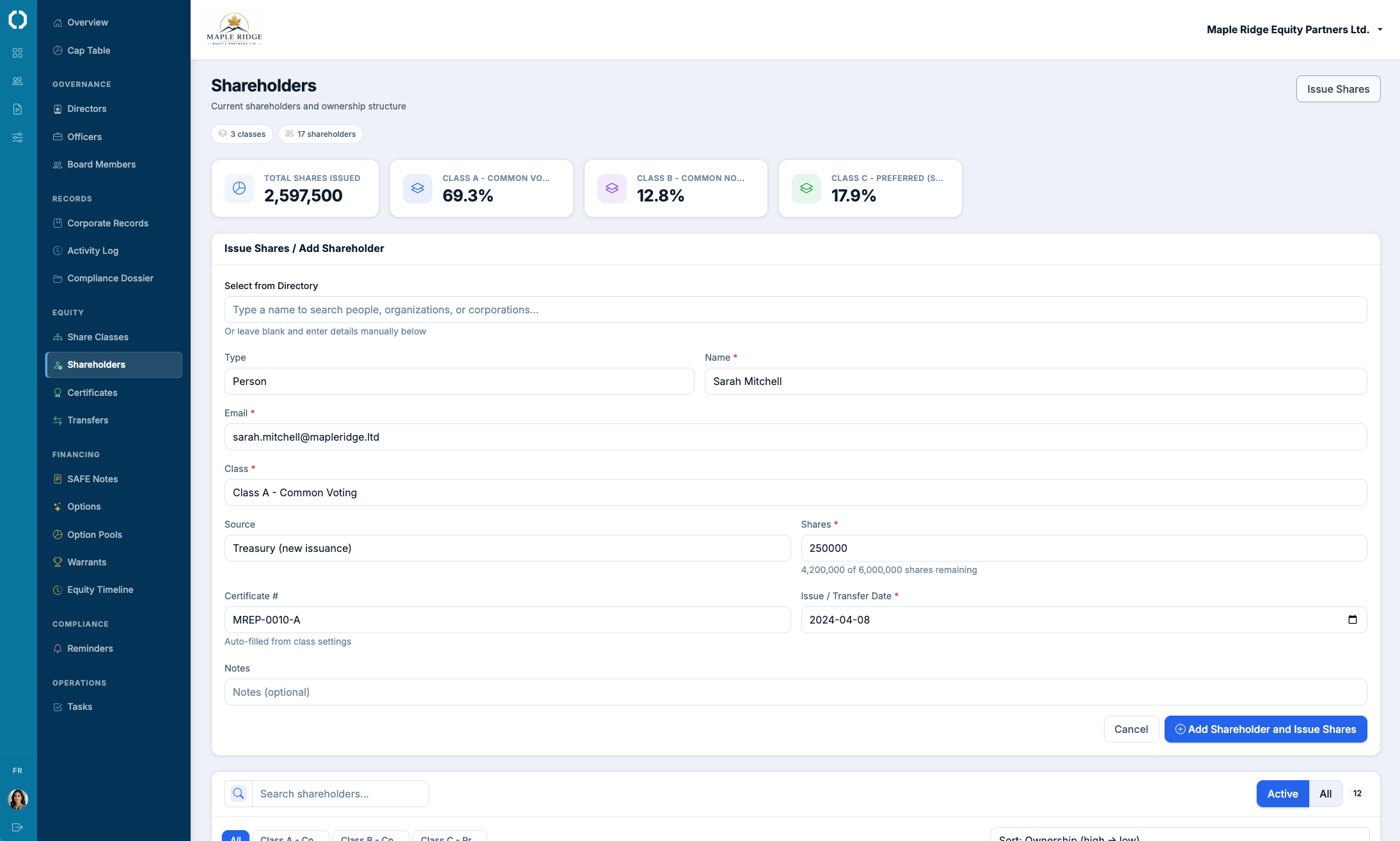
Octelligence handles NSCA specifics in the share register, certificates, board resolutions, and beneficial-ownership filings: jurisdiction-aware templates, statute citations on each record, and the right reconciliation cadence for the corporation.
See Digital Corporate RecordsCommon questions in Nova Scotia
Octelligence handles NSCA-specific share issuance: register, certificates, resolutions, and beneficial-ownership records aligned with statute.