How to maintain a share register in Canada (Federal / CBCA)
The share register is the corporation's statutory record of who owns its shares. Under Canada Business Corporations Act, the procedure follows the universal pattern with the jurisdictional specifics noted below.
| Statute | Canada Business Corporations Act |
|---|---|
| Short citation | CBCA |
| Relevant sections | s. 50 (securities register), s. 21 (inspection), s. 21.1 (ISC register) |
| Registry | Corporations Canada |
- Every entry has a date, an authorizing document, and a certificate number that ties to a physical or uncertificated record
- The register is updated on the date of the action, not retroactively
- Inspection rights vary by jurisdiction: CBCA broad, DGCL stricter, UK statutory
- The register controls when it disagrees with the cap table
- Most register failures are caused by transfers handled outside the corporation's process
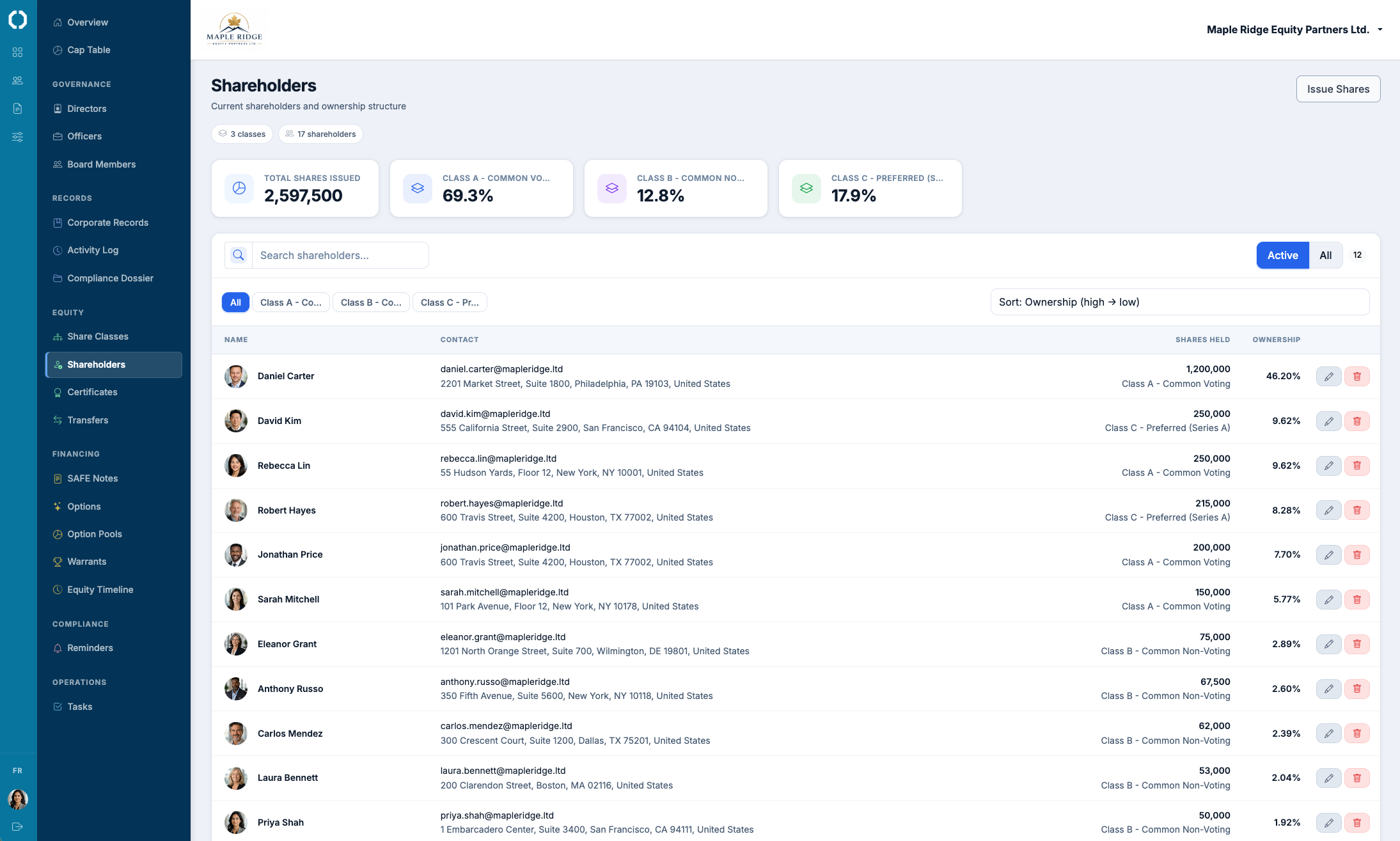
In Canada (Federal / CBCA)
The CBCA securities register under s. 50 must record every issuance, transfer, and cancellation with names, addresses, share counts, classes, certificate numbers, and dates. Inspection rights under s. 21 are broader than DGCL § 220: shareholders, creditors, and their personal representatives may inspect without a proper-purpose demonstration. The companion ISC register under s. 21.1 (Individuals with Significant Control) tracks individuals controlling 25% or more of shares or votes and must be updated within 15 days of any change. Both registers must be available at the registered office during normal business hours.
Steps
Set up the register at incorporation
At incorporation, create the register with the columns required by the corporation statute (typically: shareholder name, address, share class, share count, certificate number, consideration, date of issuance, date of transfer or cancellation). The initial entries are the founder issuances. Each entry must reference the authorizing resolution and the certificate issued. The register lives in the minute book.Record every issuance on the issuance date
When the board authorizes an issuance and the certificate is issued, the register entry is made on the same date. The entry includes the subscriber's name and address, the class and count of shares, the certificate number, the consideration received, and a reference to the authorizing resolution. Backdating is not permitted and creates an immediate audit trail problem.Record every transfer with cancellation of the old certificate
When a shareholder transfers shares, the old certificate is cancelled and a new certificate is issued to the transferee. The register records both events on the transfer date: cancellation of the prior certificate number, issuance of the new certificate number. The cancelled certificate is retained (typically by stapling it into the minute book or storing the original) so the chain of ownership is traceable. See the share transfer procedure for the full transfer mechanics.Record redemptions and cancellations distinctly
When the corporation redeems shares (buys them back from a shareholder under the redemption rights attached to the class) or cancels shares (returning them to the unissued pool), the register marks the redemption or cancellation date and the resulting share count. In jurisdictions that permit treasury shares (most US states), redeemed shares may be held in treasury rather than cancelled, which is a different entry. The board resolution authorizing the redemption or cancellation accompanies the entry.Update shareholder addresses and beneficial-ownership records
When a shareholder notifies the corporation of an address change, the register is updated. When beneficial ownership changes (a registered holder becomes the nominee of a different beneficial owner), the beneficial-ownership record is updated; under the US Corporate Transparency Act, this may also trigger a FinCEN beneficial-ownership filing. Under the CBCA and OBCA, the Individual with Significant Control (ISC) register is updated alongside the share register.Reconcile the register to issued certificates monthly or quarterly
On a monthly or quarterly cadence, the register is reconciled to the physical certificates (or uncertificated records). Every certificate that exists must have a corresponding register entry at the same date with the same share count and class. Every register entry must trace to a certificate. Discrepancies are investigated immediately and resolved by reference to the underlying authorizing document (the board resolution and subscription agreement).Produce the register on demand for inspection or diligence
The register must be available for inspection on shareholder request under most corporation statutes. The inspection right varies: under the CBCA, shareholders may inspect broadly; under DGCL § 220, shareholders must demonstrate a proper purpose. For diligence, the register is produced as the foundational record from which everything else (certificates, cap table, resolutions) is reconciled.
Common mistakes
- Transfers handled outside the corporation's process. Two shareholders agree to a transfer and exchange certificates between themselves. The corporation isn't notified, the register isn't updated, and the cap table drifts. Years later, the chain of ownership is reconstructable only from the participants' memories.
- Register maintained in a spreadsheet. The register lives in a spreadsheet that anyone can edit, with no audit trail. Versioning is by filename. The diligence problem is that there's no way to know whether the current version is the authoritative one.
- Certificate numbers skipped or reused. Certificate 17 is issued, then certificate 19, then certificate 18. Or certificate 17 is reissued to a different shareholder after the original was cancelled. The numbering inconsistency reads as poor process and forces a full reconciliation.
- Beneficial-ownership records out of sync. The ISC, PSC, UBO, or FinCEN BOI record disagrees with the share register on who actually owns the shares. The two records exist for different reasons, but they must reconcile.
- Register and cap table maintained as parallel records. The cap table is updated independently from the register, and over time they disagree. The cap table is then unverifiable because its source-of-truth has drifted.
Octelligence keeps the register as the single source of ownership, with every issuance, transfer, redemption, and cancellation recorded on the date of the action. Certificates are issued with sequential numbers and a verifiable QR link to the register entry. The cap table regenerates from the register on demand.
See Digital Corporate RecordsCommon questions
Live share register, sequential certificate numbering, transfers handled inside the system, and a cap table that always agrees with the underlying record.