How to run an annual meeting in Delaware
An annual meeting of shareholders is required under every common-law corporation statute. Under Delaware General Corporation Law, 8 Del. C. tit. 8, the procedure follows the universal pattern with the jurisdictional specifics noted below.
| Statute | Delaware General Corporation Law, 8 Del. C. tit. 8 |
|---|---|
| Short citation | DGCL |
| Relevant sections | § 211 (annual meeting), § 228 (majority written consent) |
| Registry | Delaware Division of Corporations |
- Notice must be given a minimum number of days in advance (varies by jurisdiction; typically 21 days)
- Quorum is set in the bylaws (typically a majority of voting shares)
- Standard agenda: financial statements, auditor report, director elections, auditor appointment
- Written consent of shareholders substitutes for the meeting in most jurisdictions, with constraints
- Audited financial statements may be required depending on shareholder count and revenue
In Delaware
Delaware annual meetings under DGCL § 211 must be held annually for the election of directors and any other proper business. Notice is required 10-60 days in advance under § 222. Delaware's distinctive feature is § 228: majority written consent of stockholders substitutes for the meeting on most matters (other than director election by ballot in certain circumstances). This is unusual among US states and is a frequent operational reason for Delaware incorporation: small private corporations can avoid the procedural overhead of actual annual meetings while still meeting statutory requirements.
Steps
Set the date and prepare the financial statements
The board sets the meeting date, subject to the statutory window. The corporation's financial statements for the most recent fiscal year are prepared and (if applicable) audited or reviewed. The auditor or independent accountant signs off on the statements. The directors approve the statements for presentation to shareholders. Without approved statements, the meeting cannot complete its statutory business.Prepare the notice of meeting and proxy materials
The notice of meeting sets out the date, time, place (or electronic meeting platform), and the matters to be considered. The standard matters are: receipt of the financial statements and auditor's report, election of directors, appointment of auditor, and any other business permitted by the bylaws. Proxy forms are prepared and included with the notice; the proxy form permits a shareholder unable to attend to direct a proxy holder how to vote. For private corporations with a small shareholder base, the proxy infrastructure may be informal, but the substance is the same.Send the notice within the statutory window
Notice is delivered to every shareholder of record as of the record date set by the board. The minimum notice period varies (DGCL § 222 requires 10-60 days for stock corporations; CBCA s. 135 requires 21-60 days; Companies Act 2006 requires 21 days). The notice is sent by the method specified in the bylaws (typically post or electronic mail). A shareholder may waive notice in writing, which is the standard practice for small private corporations where all shareholders are reachable and consent.Hold the meeting
On the meeting date, the meeting is convened. The chair confirms quorum (typically a majority of voting shares present or represented by proxy). The minutes-taker records attendance. The chair walks through the agenda in order. The financial statements are received; questions are taken. Directors are elected for the next term; the slate may be uncontested or contested depending on the corporation. The auditor is appointed for the next year. Any other business listed in the notice is considered. The meeting is then adjourned.Pass the resolutions
Each agenda item that requires a vote is passed as a shareholder resolution: appointment of the auditor, election of each director (typically slate election, sometimes individual), and approval of any other items. Voting is by show of hands unless a shareholder demands a poll, in which case voting is by share count. The resolutions are recorded in the minutes and may be repeated as separate written resolutions for the minute book.Prepare and approve the minutes
The minutes record the meeting: attendance, quorum confirmation, the agenda items considered, the resolutions passed, the vote counts (or unanimity), and the time of adjournment. The minutes are signed by the chair and the secretary. At the next meeting (or by written resolution shortly after), the directors approve the minutes as accurate.File the meeting materials in the minute book
The notice of meeting, proxy forms received, attendance list, financial statements approved, auditor's report, executed resolutions, and signed minutes all go into the minute book. The annual filing (annual return, annual report, confirmation statement, etc.) with the corporate registry may flow from the meeting; the filing is made within the statutory window.
Common mistakes
- Meeting held outside the statutory window. The corporation misses the deadline (typically 15 months from the last meeting, or 6 months from fiscal year end, depending on the statute). The meeting must still be held; in many jurisdictions, missed-meeting penalties or corporate-registry consequences follow.
- Quorum not confirmed. The minutes don't record whether quorum was achieved. Diligence counsel reads the omission as an open question on whether the resolutions passed are valid.
- Director elections not recorded individually. A slate of directors is elected without identifying which directors. Years later, the corporate registry's record of directors disagrees with the minute book and reconstruction is difficult.
- Written-resolution path used where the statute requires a meeting. A private corporation tries to substitute written consent for the meeting where the statute requires unanimous consent and one shareholder hasn't signed. The resolutions are invalid until the consent is unanimous or a proper meeting is held.
- Financial statements not approved before the meeting. The financial statements are presented at the meeting but the directors haven't approved them in advance. The statements then can't be presented as approved by the board.
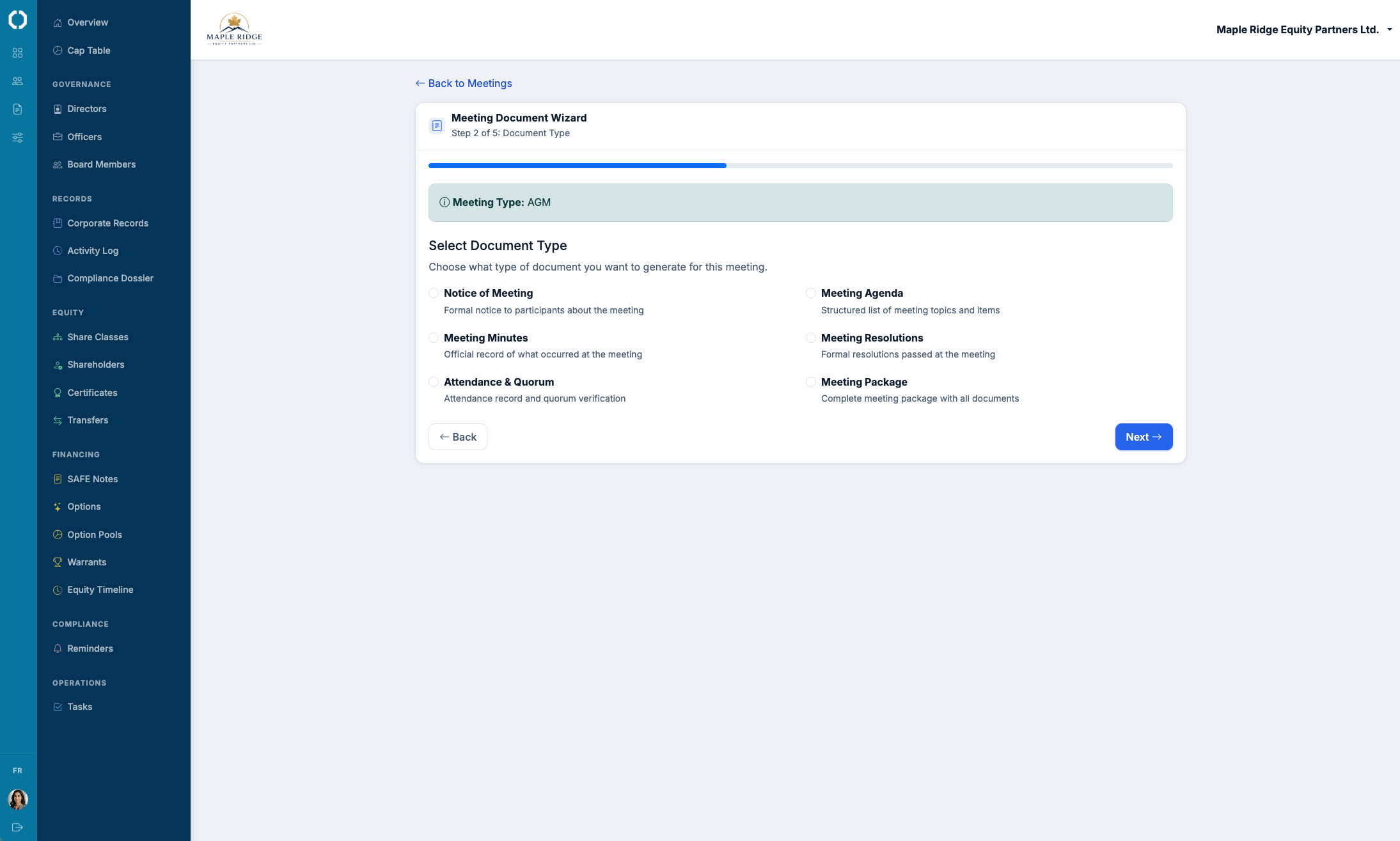
Octelligence runs the AGM as a guided workflow: financial statements approved, notice generated, proxies tracked, meeting minutes drafted, resolutions executed, annual filing prepared. The minute book reflects the meeting on the meeting date.
See Digital Corporate RecordsCommon questions
Statement approval, notice generation, meeting minutes, executed resolutions, and the annual filing, all from one place.