How to file an annual return in Canada (CBCA)
The CBCA annual return under s. 263 is filed within 60 days after the corporation's anniversary date. Corporations Canada administers the filing through its Online Filing Centre. The $20 online fee is the lowest among priority jurisdictions. Failure to file for 2 consecutive years triggers administrative dissolution under s. 212. The ISC register information (added in 2019, amended in 2024) is filed with Corporations Canada at the same cycle.
| Form | Form 22 Annual Return |
|---|---|
| Registrar | Corporations Canada |
| Due date | Within 60 days after the anniversary date |
| Fee | $20 online ($40 by paper) |
| Late penalty | No direct fee; administrative dissolution after 2 years |
| Form | Form 22 Annual Return |
| Registrar | Corporations Canada |
| Due date | Within 60 days after the anniversary date |
| Fee | $20 online ($40 paper) |
| Late penalty | No direct fee; administrative dissolution after 2 years |
| Failure to file | Administrative dissolution under CBCA s. 212 |
- CBCA annual return under s. 263, filed within 60 days of anniversary date
- $20 online filing fee, one of the lowest among priority jurisdictions
- ISC register information (added in 2019, expanded in 2024) is filed at the same cycle
- Administrative dissolution under s. 212 after 2 consecutive years of non-filing
- Corporations Canada administers via its Online Filing Centre
The CBCA annual return regime
The CBCA annual return under s. 263 is a simple information filing with Corporations Canada. The filing reports the corporation's registered office address (or change), directors (names and addresses), and the corporation's continued existence. The filing is due within 60 days of the corporation's anniversary date (the date of incorporation or continuance into the CBCA).
The Online Filing Centre
Corporations Canada's Online Filing Centre at corporationscanada.ic.gc.ca is the filing portal. The system handles annual returns, articles amendments, director changes, registered-office changes, and dissolutions. The CBCA filing system is among the simpler and lower-cost regulatory regimes among priority jurisdictions.
ISC register filing since 2019 and 2024 amendments
The CBCA Individuals with Significant Control (ISC) register, added in June 2019 and expanded in January 2024, requires every CBCA corporation to maintain a register of beneficial owners (individuals controlling 25% or more) and to file portions of this information with Corporations Canada. The 2024 amendments expanded the public-disclosure portion. ISC information is filed annually with the annual return or upon any change.
Administrative dissolution under s. 212
A corporation that fails to file an annual return for 2 consecutive years may be dissolved by the Director (Corporations Canada) under CBCA s. 212. Notice is provided to the registered office before dissolution. Revival under s. 209 is possible by filing all missed annual returns and paying the revival fee ($200).
Reconciliation to the minute book
The Form 22 Annual Return reflects the corporation's directors as of the filing date. Confirm against the minute book that the directors named in the filing match the directors actually serving (elected at the most recent annual meeting or by written resolution). Discrepancies are corrected by board action and minute-book entry, not by the filing itself.
Procedure
The annual-return procedure as it applies in Canada (CBCA), in seven steps:
Identify the anniversary date
The corporation's anniversary date is the date of incorporation (or continuance into the CBCA). The annual return is due within 60 days after this date each year. Confirm by checking the corporation's record on the Corporations Canada online register.Confirm current directors against the minute book
The annual return lists the corporation's directors with addresses. Confirm against the minute book that the named directors are the directors actually serving. Director changes that occurred during the year (resignations, appointments) should have been filed under CBCA s. 113 separately; the annual return reflects the resulting current state.Confirm registered office address
The registered office must be in Canada in the province specified in the articles. Confirm currency. Changes during the year are filed under s. 19; the annual return reflects the current state.Prepare ISC register information for filing
The ISC register lists Individuals with Significant Control. Prepare the current ISC information for filing with the annual return. Note: the 2024 amendments expanded which portions are made public; review the current disclosure rules.File the annual return online through Corporations Canada
Login to the Online Filing Centre. Select "Annual Return". Confirm or update the displayed information. Pay $20 by credit card.Verify filing acceptance
Corporations Canada issues an immediate filing acknowledgment with a transaction number. Retain the acknowledgment.Place the filing in the minute book
The filed Form 22, the ISC register update, the Corporations Canada acknowledgment, and the payment receipt are placed in the minute book under the year's annual filings.
Common mistakes
The CBCA annual return is simple but the ISC integration adds complexity. Common errors:
- Conflating the annual return with the corporate tax return; they are different filings with different agencies.
- Failing to update ISC register information; the ISC obligation is ongoing and the annual return is one of several reporting points.
- Missing the 60-day window after anniversary date; many founders track calendar months rather than anniversary dates.
- Allowing administrative dissolution under s. 212; revival is possible but adds cost and complexity over staying current.
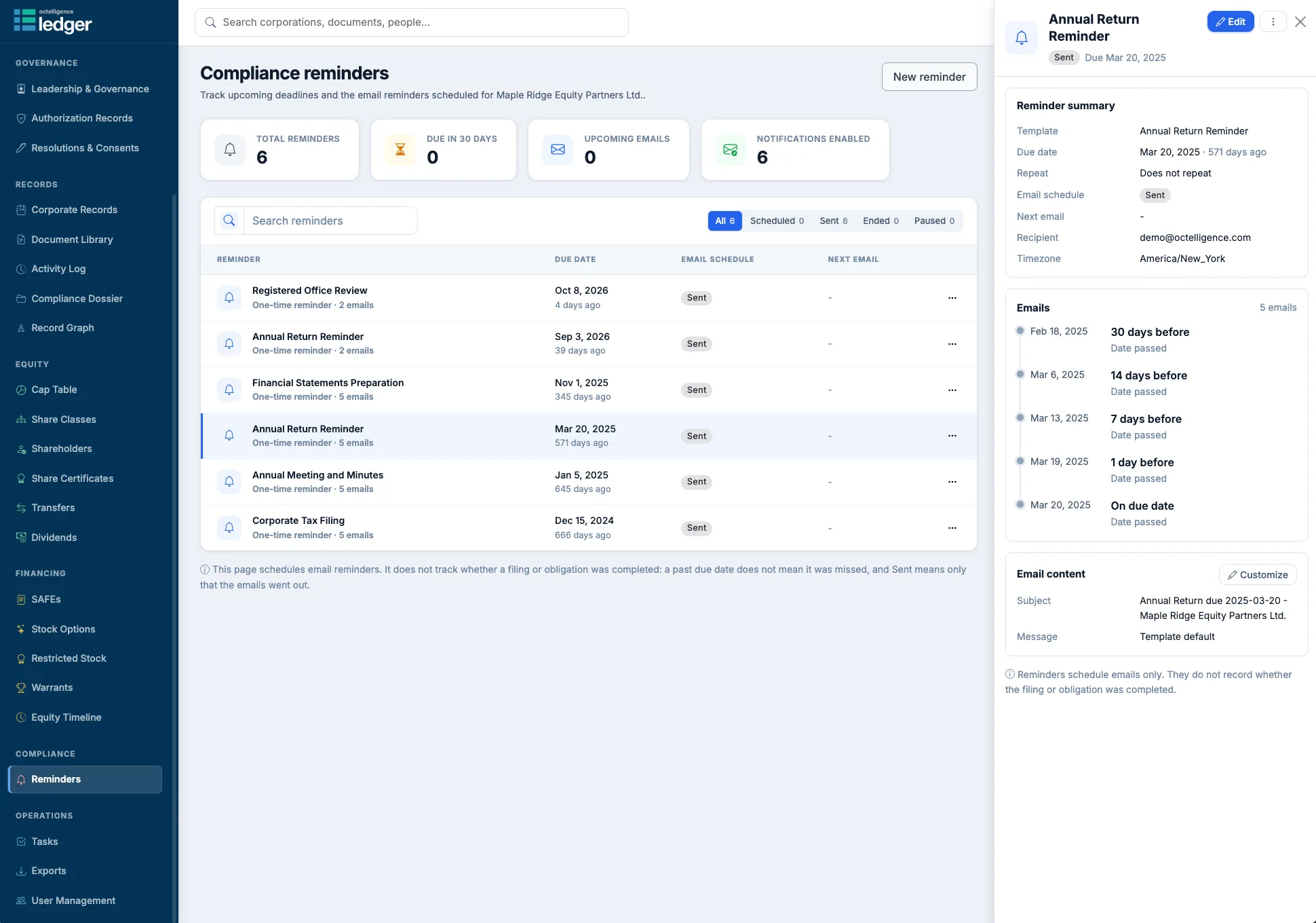
Octelligence tracks the CBCA annual-return deadline against the corporation's anniversary date or fiscal year-end, surfaces the directors, registered office, and beneficial-ownership information for the filing, and stores the filed return alongside the minute book. The jurisdiction-specific form, fee, and late-penalty rules are built in, with multi-jurisdiction portfolio views for corporations registered in more than one place.
See Digital Corporate RecordsCommon questions in Canada (CBCA)
Octelligence calendars the CBCA annual-return deadline, prepares the filing against the live minute book, and stores the receipt alongside the records it confirms.